- Spanish-Latin America
- Japanese-JP
- Chinese
- Europe
- Português-BR

Tech Support
(888) 598-9901
Hours: Mon-Fri 8AM-8PM EST
nep-usa@site_ea168614-f5f4-4298-bd5b-880b4cf8d99d
Why Choose a Battery Study Lamp for Schools?
Schools need dependable light where students read, write, and complete quiet tasks. A Battery Study Lamp can support that work when classroom outlets are distant or a supervised study area needs flexible lighting. Its value is practical: a charged lamp can move from a desk to a reading corner without trailing cords across the floor. Small details matter. A stable base, simple controls, and a shade that directs light onto a workbook can make daily use easier.
Battery capacity, brightness, charging time, and build quality deserve close attention. A lamp that looks bright in a product photo may still create glare on glossy pages. Staff should test it on an actual desk, with real books, before choosing a model for several classrooms. Elena Morris, a fictional school-lighting specialist included here as an illustrative voice, puts the principle this way: “Good study lighting should reach the page clearly, without making the student fight the lamp.” This is an example quotation, not a verified statement from a real expert.
Battery lamps also need routines. Someone must check charging, storage, and safe placement. That takes effort. It is easy to overlook. Schools should compare tested runtime with the length of a normal study session, rather than relying on a headline specification alone. A Battery Study Lamp can offer useful flexibility, but it is not automatically the best fit for every classroom. Trial use may reveal problems that a catalogue cannot. That is worth admitting.
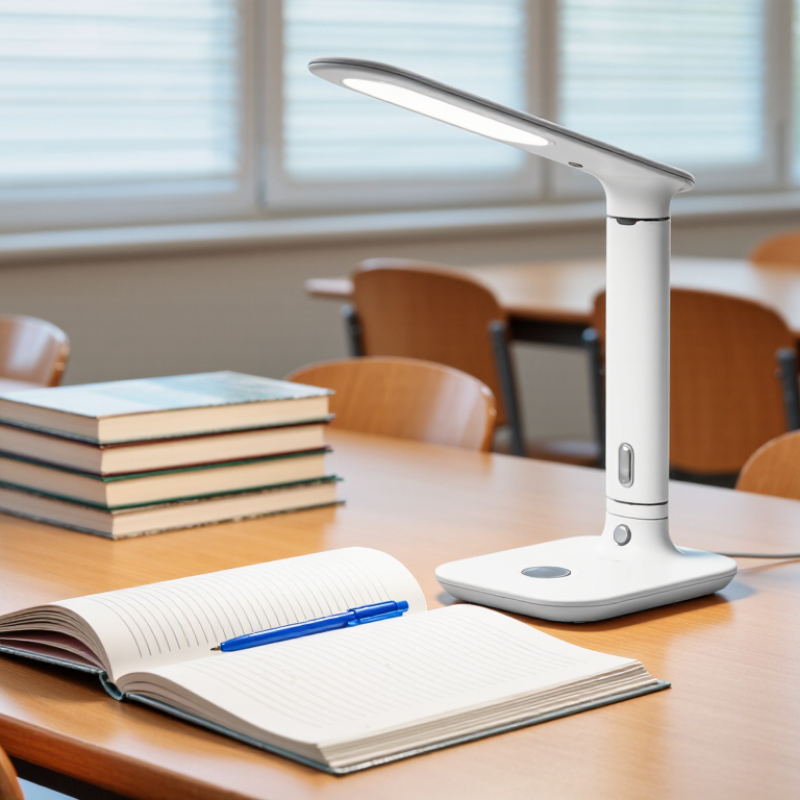
Classroom Lighting Needs: EN 12464-1 Specifies 500 lx for Teaching Areas
A classroom needs more than a bright-looking ceiling. EN 12464-1 uses 500 lx as a maintained illuminance benchmark for many teaching areas. This means light measured on the working surface, such as a student’s desk, not the lamp’s brightness rating. Lux matters.
A battery study lamp can add focused light when a desk sits in a shadow, or when daylight fades during afternoon lessons. Look for a stable base, a glare-controlled head, and adjustable brightness. A teacher can check the desk with a lux meter, placing it flat where students read or write. Measurements may vary across the room. That detail is easy to miss.
A portable lamp is a supplement, not a substitute for balanced classroom lighting. One bright pool on a worksheet does not ensure even light across a teaching area, and reflections on a whiteboard can still distract students. Battery life also deserves a real-world test: a lamp that dims before the last lesson is not much help. Requirements can depend on the task and applicable standard edition, so schools should verify their lighting plan rather than treat 500 lx as a one-size-fits-all answer.
Get in touch
Our mission is to develop cutting-edge clean energy technology and provide next-generation solar inverters.
Phone
(888) 598-9901
nep-usa@site_ea168614-f5f4-4298-bd5b-880b4cf8d99d
