- Spanish-Latin America
- Japanese-JP
- Chinese
- Europe
- Português-BR

Tech Support
(888) 598-9901
Hours: Mon-Fri 8AM-8PM EST
nep-usa@site_ea168614-f5f4-4298-bd5b-880b4cf8d99d
Why Are Carbon Fiber Products in High Demand?
Why are carbon fiber products in high demand? The answer begins with a practical advantage: they can deliver high strength at low weight. That matters when aircraft makers seek lighter structures, wind-energy companies build larger turbines, and vehicle manufacturers work to reduce mass. Carbon fiber is not a universal fix. Its price and manufacturing demands still limit some applications.
Grand View Research valued the global carbon fiber market at approximately $5.48 billion in 2023 and forecast an 11.0% compound annual growth rate from 2024 to 2030. This is a market forecast, not a guarantee. The Global Wind Energy Council reported 117 gigawatts of new wind capacity in 2023, illustrating one expanding market for advanced composite materials. Yet not every turbine component uses carbon fiber; material choices depend on design, cost, and performance.
A useful expert perspective comes from Dr. Uday Vaidya, a composites researcher and the University of Tennessee’s chief technology officer for the Institute for Advanced Composites Manufacturing Innovation. As a paraphrase of the manufacturing challenge emphasized in his work: adoption depends on making advanced composites practical to produce at scale, not merely strong in a laboratory. That distinction matters. The benefits are visible in a lightweight bicycle frame or aircraft component, but so are the trade-offs in cost, repair, and end-of-life handling. The gains are real. Not effortless. Understanding both sides helps explain why demand is rising—and why it will vary by product and industry.
What Carbon Fiber Products Are and How They Are Made
Why Are Carbon Fiber Products in High Demand?
What Carbon Fiber Products Are and How They Are Made
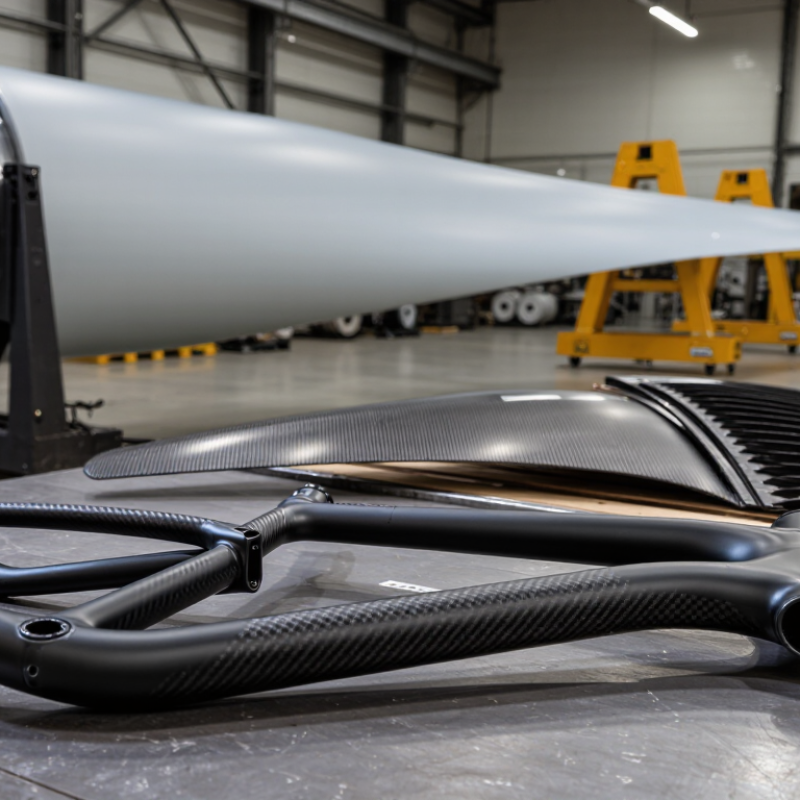
Carbon fiber products are made from thin carbon-based filaments, bundled into yarn and combined with a polymer resin. The result is a composite: fibers carry much of the load, while resin holds them in shape. Making the fibers involves heating a precursor, often polyacrylonitrile, through controlled stabilization and high-temperature carbonization. Manufacturers then weave or layer the fibers, add resin, and cure the shaped part under heat or pressure. A finished panel may show a fine woven pattern, but its strength depends on fiber direction, resin quality, and careful production.
Products range from sporting goods to vehicle and aircraft components. Grand View Research estimated the global carbon fiber market at USD 5.48 billion in 2023. That figure reflects market value, not the quantity or performance of every product. Carbon fiber can be lightweight and stiff, but it is not automatically the best choice. Resin systems, repair needs, and end-of-life handling matter too. These trade-offs deserve more attention than they often receive.
Tips: Check the product’s intended load and fiber orientation. A glossy surface alone tells you little. Ask whether the part is solid laminate or a thin decorative layer.
Get in touch
Our mission is to develop cutting-edge clean energy technology and provide next-generation solar inverters.
Phone
(888) 598-9901
nep-usa@site_ea168614-f5f4-4298-bd5b-880b4cf8d99d
