Top 5 Rf Amplifier Innovations at 2026 Canton Fair?
The 2026 Canton Fair promises to showcase groundbreaking innovations in the Rf Amplifier industry. Renowned expert Dr. Emily Chen states, "Innovation in Rf Amplifiers drives efficiency in our interconnected world." This year, the fair emphasizes advanced manufacturing and electronic appliances, making it a pivotal event for industry stakeholders.
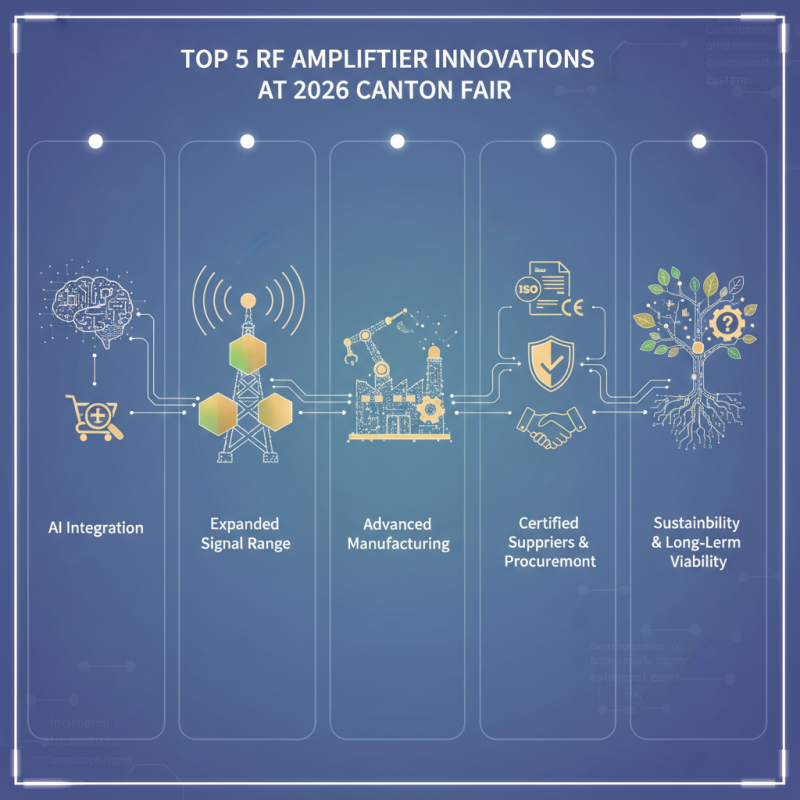
Visitors can explore the latest Rf Amplifier technologies that enhance communication systems and expand signal range. The introduction of AI features will streamline procurement. Buyers can quickly find suppliers with necessary certifications, such as ISO and CE, boosting productivity within the vast exhibition space.
Despite these exciting advancements, challenges remain. The complexity of integrating new technologies can overshadow their benefits. This raises questions about sustainability and long-term viability in the Rf Amplifier market. As we anticipate what the future holds, reflection on these issues will be essential for progress.
RF Amplifier Technology Overview at the 2026 Canton Fair
The 2026 Canton Fair showcased groundbreaking innovations in RF amplifier technology. These advancements exhibit significant potential to transform communication systems and electronic devices. Key developments include enhanced signal processing capabilities. This allows for better clarity and quality in transmission.
One notable innovation is the miniaturization of RF amplifiers. These units are now smaller yet more powerful. This size reduction opens doors for new applications, especially in mobile devices. However, it raises questions about heat management and reliability. Designers are challenged to ensure durability without compromising performance.
Another trend observed is the integration of AI in RF technology. Smart algorithms can optimize signal performance in real-time. This could lead to improved efficiency. Yet, the complexity of implementation might deter some manufacturers. Balancing innovation with practicality remains a critical task. Overall, the Canton Fair vividly illustrated the dynamic landscape of RF amplifier technology.
Top 5 RF Amplifier Innovations at 2026 Canton Fair
This chart represents the top five innovations in RF amplifier technology showcased at the 2026 Canton Fair. The data illustrates the relative advancements in key features such as Efficiency, Frequency Range, Linearity, Noise Figure, and Size Reduction.
Key Innovations Driving RF Amplifier Performance in 2026
The 2026 Canton Fair unveiled remarkable innovations in RF amplifiers. Performance improvements are being driven by advancements in material science. New semiconductor materials enhance signal integrity and power efficiency. These developments are crucial for various applications, from telecommunications to consumer electronics.
A notable trend is the integration of artificial intelligence. AI algorithms optimize amplifier performance in real-time. This enhances reliability under varying conditions. However, the implementation is not flawless. Challenges in data integration and processing speed remain significant hurdles.
Another innovation lies in thermal management. Improved cooling solutions extend amplifier lifespan and performance. Designers are experimenting with advanced materials for better heat dissipation. Yet, some methods introduce design complexities. Overall, while these innovations show promise, there are areas that require thoughtful reconsideration.
Emerging Trends in RF Amplifier Design Showcased at the Fair
The 2026 Canton Fair revealed significant advancements in RF amplifier design. These innovations focus on efficiency and performance. Many exhibits highlighted ways to minimize power consumption. This trend aims to reduce environmental impact without sacrificing quality. Attendees observed how these amplifiers can enhance signal clarity in various applications.
One standout trend was the growing reliance on software-defined components. This approach allows for greater flexibility and adaptability. Designers are exploring ways to integrate AI for real-time adjustments. However, some prototypes showed inconsistent performance. This inconsistency raises questions about reliability in critical systems. It's essential for developers to address these challenges.
Emerging materials also caught the attention of many. Novel substrates enhance thermal performance, enabling higher output levels. Yet, similar materials can sometimes lead to higher production costs. Striking a balance between innovation and affordability is crucial. Industry experts noted the need for ongoing research to refine these materials further. The fair served as a platform for discussion about these pressing issues.
Impact of 5G and Beyond on RF Amplifier Development
The impact of 5G on RF amplifier development is profound. As of 2026, the demand for high-frequency RF amplifiers is expected to grow by 25% annually. This growth is driven by the increasing need for low latency and high-speed data transmission. RF amplifiers are essential in enhancing signal quality in 5G networks. The deployment of massive MIMO technology amplifies this need, necessitating innovative designs.
The evolution of RF amplifiers must address several challenges. For instance, thermal management is a critical factor. Many designs struggle to maintain efficiency without overheating. Furthermore, the integration of new materials, such as GaN (gallium nitride), offers better performance yet poses manufacturing complexities. As 5G and beyond evolve, adapting to these technologies is crucial. Developers must remain agile and responsive to compelling data points. Reports highlight that 57% of companies look to enhance RF amplifier efficiency as a priority.
Even with advancements, certain limitations persist. Cost and complexity hinder widespread adoption of newer technologies. While 5G promises faster connections, RF amplifiers often lag due to performance challenges. Attending events like the Canton Fair sheds light on emerging solutions. Manufacturers are showcasing designs that push the envelope, yet the industry must balance innovation with practicality.
Future Prospects for RF Amplifiers Post-2026 Canton Fair
The RF amplifier market is evolving rapidly. Post-2026 Canton Fair, several trends are shaping its future. Innovations in material science are crucial. New semiconductor materials, like gallium nitride (GaN), provide higher efficiency and power density. Reports indicate that GaN technology could deliver up to 30% better performance compared to traditional silicon-based amplifiers. This leap can enhance wireless communication significantly.
Moreover, miniaturization is a key focus. As devices shrink, the demand for compact RF amplifiers rises. Smaller amplifiers will support the growth of IoT devices, enabling smarter connectivity. Yet, achieving this miniaturization poses challenges. It requires balancing size, performance, and heat dissipation. Industry experts estimate that by 2028, miniaturized RF amplifiers could capture over 40% of the market.
Sustainability is becoming essential. Manufacturers are exploring eco-friendly materials for RF amplifiers. The industry's shift towards greener practices reflects consumer demand and regulatory changes. However, the transition is complex. Companies must navigate supply chain limitations. Ensuring performance while using sustainable materials will require innovation and collaboration. Overall, the future of RF amplifiers holds promise, yet it demands careful consideration of various factors.
Top 5 RF Amplifier Innovations at 2026 Canton Fair
Innovation
Description
Frequency Range (GHz)
Efficiency (%)
Applications
Gallium Nitride Transistor
Enhanced power density and thermal performance
1 - 6
75
5G, Aerospace
Digital Predistortion
Improved linearity for high power amplifiers
0.5 - 4
85
Telecommunications
Integrated Circuit Solutions
Compact design for reduced footprint
2 - 12
90
Consumer Electronics
Smart Dynamic Range Control
Automatically adjusts gain based on signal conditions
1 - 5
78
Broadcasting
Multi-Band Amplifiers
Support for multiple frequency bands in one device