- Spanish-Latin America
- Japanese-JP
- Chinese
- Europe
- Português-BR

Tech Support
(888) 598-9901
Hours: Mon-Fri 8AM-8PM EST
nep-usa@site_ea168614-f5f4-4298-bd5b-880b4cf8d99d
Top Frameless Sliding Door Manufacturers for Global Buyers
Frameless Sliding Doors bring daylight into a room while keeping sightlines open. Their minimal appearance can make a compact apartment feel less enclosed, or connect a living space with a garden. But the glass is only part of the decision. Track alignment, roller quality, seals, hardware, and installation support all affect how smoothly a door performs over time.
Architect Ludwig Mies van der Rohe’s famous principle, “Less is more,” captures the appeal of this design. It also points to a practical challenge: with fewer visible frames, small flaws become easier to notice. A dragging panel. A gap that lets in a draft. Details matter.
This guide compares frameless sliding door manufacturers for global buyers, with attention to product range, customization, materials, certifications, and export support. Buyers should check the glass specification, operating hardware, warranty terms, and availability of replacement parts before placing an order. Ask for technical drawings and project references, not just polished photographs. Requirements differ by building and market, so confirm local specifications with qualified professionals. A showroom sample may slide perfectly; real-world use can be less forgiving. That is worth remembering.
What Defines a Frameless Sliding Door and How Does It Work?
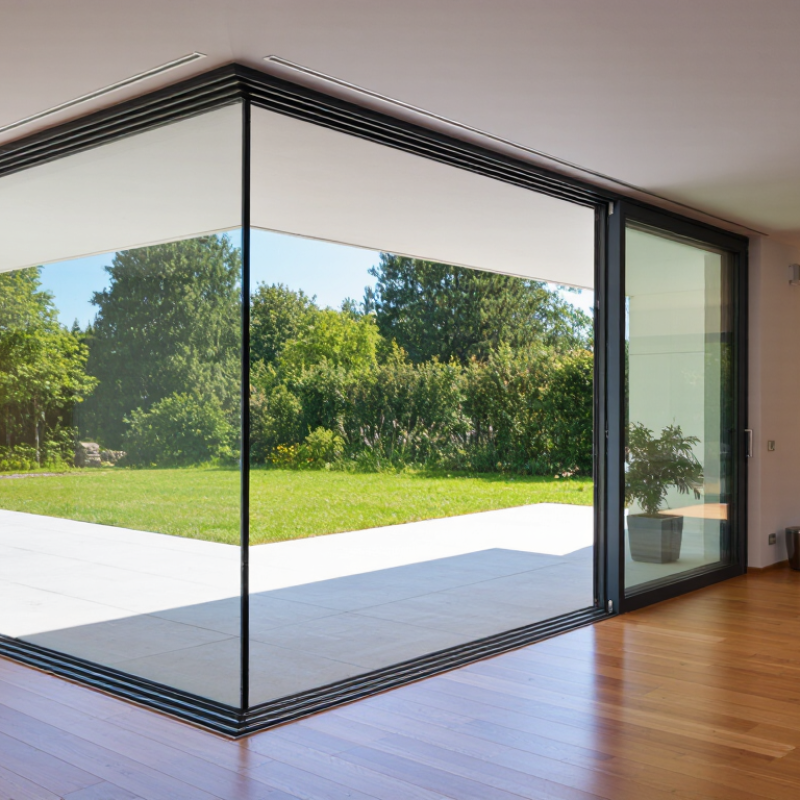
A frameless sliding door uses large glass panels with minimal visible framing. “Frameless” is a design description, not a claim that the door has no supporting hardware. Rollers carry each panel along a floor track or overhead rail, while guides help prevent sideways movement. The glass edges remain exposed or lightly covered, creating a clear, open view. That distinction matters.
When one panel slides behind another, the opening stays partly occupied; it does not vanish completely. Seals between panels and at the jamb help limit drafts, but they are not always airtight. Panel weight, glass thickness, track alignment, and floor level all affect smooth operation. A slightly uneven floor can make a heavy panel feel rough. The U.S. Department of Energy estimates that windows account for 25–30% of residential heating and cooling energy use. That figure covers windows generally, not frameless sliding doors specifically, but it shows why glass performance deserves attention. Buyers should compare tested U-factor and solar heat gain coefficient values, where available, and check that the hardware rating matches the panel size and weight. A common oversight is focusing only on appearance; cleaning exposed edges and keeping tracks free of grit also matter. I would not assume “frameless” means maintenance-free.
Get in touch
Our mission is to develop cutting-edge clean energy technology and provide next-generation solar inverters.
Phone
(888) 598-9901
nep-usa@site_ea168614-f5f4-4298-bd5b-880b4cf8d99d
