- Spanish-Latin America
- Japanese-JP
- Chinese
- Europe
- Português-BR

Tech Support
(888) 598-9901
Hours: Mon-Fri 8AM-8PM EST
nep-usa@site_ea168614-f5f4-4298-bd5b-880b4cf8d99d
What Are the Top 10 Types of Sound Bowl Instruments?
Interest in sound-based wellness is growing, though popularity alone does not establish a health benefit. The Global Wellness Institute’s 2024 Global Wellness Economy Monitor estimated the global wellness economy at $6.3 trillion in 2023. That figure offers useful industry context, not proof that singing bowls treat any condition. A Sound Bowl Instrument is better understood by its material, shape, tuning, and playing method than by broad wellness promises.
This guide compares ten commonly encountered types, including metal Tibetan-style bowls, quartz crystal bowls, frosted crystal bowls, and models marketed as chakra-tuned or made with added minerals. Their differences are tangible: a metal bowl may feel cool and textured, while a large crystal bowl can produce a clear, sustained tone. Mallets matter, too. A soft suede-covered striker and a firm wooden one can draw different sounds from the same bowl.
Names can be confusing. Some categories overlap, and sellers do not always use labels consistently. That distinction matters. The guide therefore focuses on observable features, typical sound, practical handling, and questions to ask before buying. Claims about special frequencies or guaranteed emotional effects deserve careful scrutiny; evidence for a particular bowl type may be limited. Not every claim holds up. Use this comparison as a grounded starting point, then listen in person when possible. A bowl that sounds calming in a recording may feel sharp in a small room.
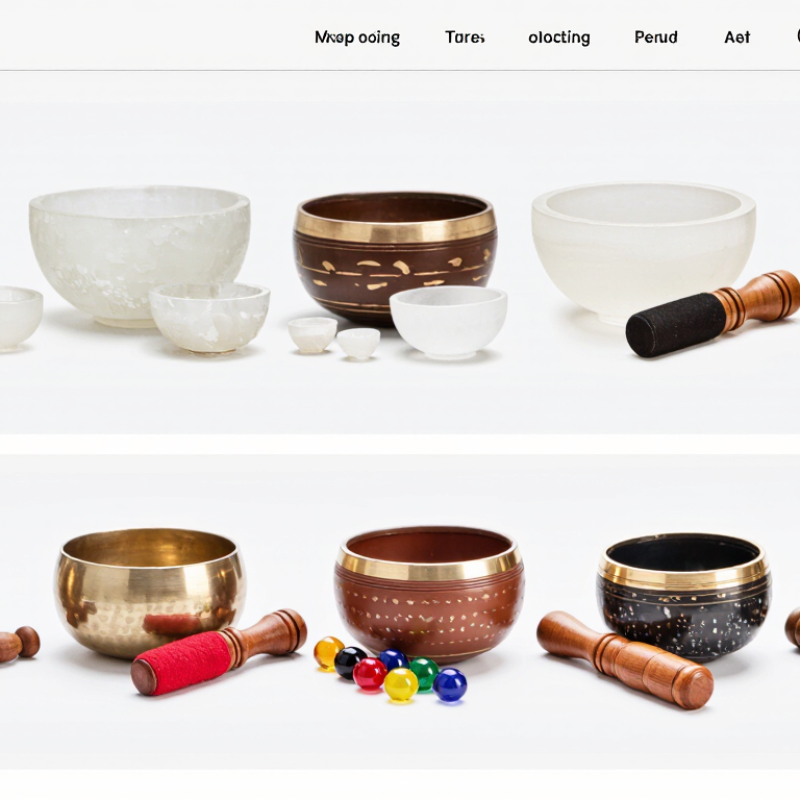
Key Features Used to Identify Sound Bowl Instruments
Sound bowls are easiest to identify by examining their material, shape, rim, and sound together. Metal bowls often have a visible hammered surface, with small dents that catch the light. Their walls may vary in thickness, and the rim can feel slightly uneven. Crystal bowls are commonly translucent, with smooth sides and a more uniform shape. Look closely.
Size offers clues, but it does not identify a bowl on its own. A wider bowl may produce a lower tone, while a smaller one often sounds higher. Yet wall thickness, material, and playing technique also affect pitch and resonance. When struck gently, listen for how the note begins and how long it lingers. Rubbing the rim with a suitable mallet may create a sustained tone, though not every bowl responds easily. Not always. A bright sound does not prove that a bowl is crystal, and a long sustain does not confirm its origin. It is easy to overread one feature. Compare the bowl’s appearance, weight, rim, and sound before naming its type.
Get in touch
Our mission is to develop cutting-edge clean energy technology and provide next-generation solar inverters.
Phone
(888) 598-9901
nep-usa@site_ea168614-f5f4-4298-bd5b-880b4cf8d99d
