- Spanish-Latin America
- Japanese-JP
- Chinese
- Europe
- Português-BR

Tech Support
(888) 598-9901
Hours: Mon-Fri 8AM-8PM EST
nep-usa@site_ea168614-f5f4-4298-bd5b-880b4cf8d99d
China Top 10 Polarization Modulator Manufacturers?
Polarization Modulators are precision optical components used to control a beam’s polarization state in fiber-optic communications, sensing, and laboratory systems. Their performance can influence signal quality, measurement repeatability, and system stability. Yet a product name alone tells little. Buyers need to examine operating wavelength, bandwidth, insertion loss, extinction ratio, drive voltage, and environmental tolerance.
Demand for capable optical networks provides useful context. Cisco’s Annual Internet Report (2018–2023) forecast global internet traffic at 396 exabytes per month by 2022, up from 122 exabytes per month in 2017. This was a forecast, not a measured 2022 result. Still, it shows why high-capacity optical infrastructure draws sustained attention. A modulator is only one part of that infrastructure, but small component differences can matter across a link.
This guide examines ten China-based manufacturers and suppliers associated with polarization modulation products. It compares public specifications, application focus, customization options, and available evidence of quality management. No single ranking fits every project. Some catalog details may also be incomplete or difficult to compare directly. That limitation deserves attention. Use this list as a starting point, then confirm current datasheets, sample performance, and support arrangements with each supplier.
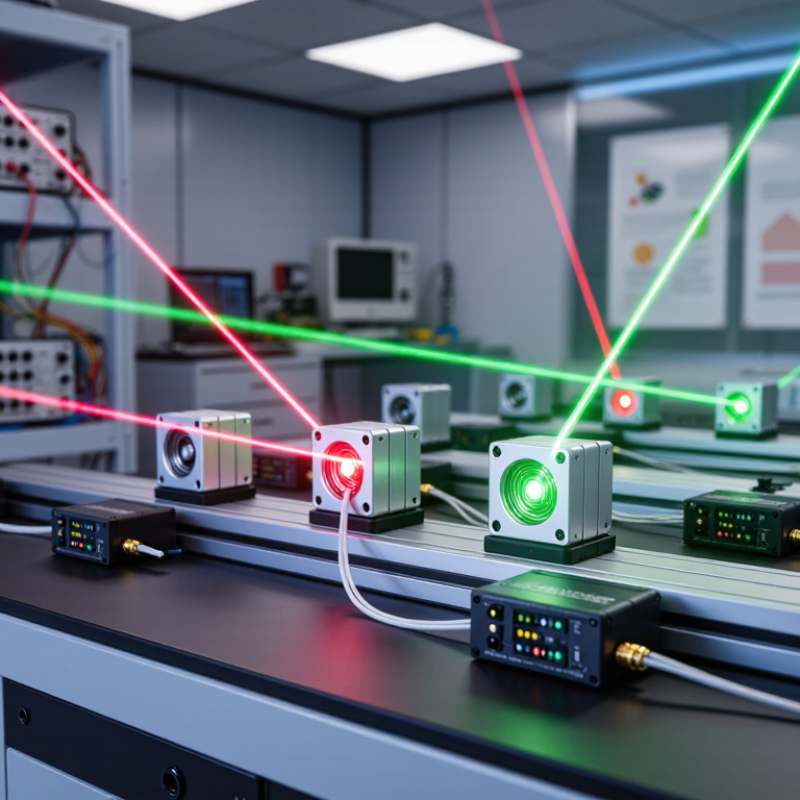
What Is a Polarization Modulator and How Does It Work?
A polarization modulator controls the orientation or shape of light’s electric field as it travels through an optical system. Unlike an intensity modulator, it can change polarization while keeping the beam’s brightness nearly constant. In a common electro-optic design, an applied voltage changes a crystal’s refractive index. Light aligned with two perpendicular crystal axes then accumulates different phase delays. The resulting phase difference sets the output polarization: linear, circular, or somewhere between. Small voltage changes can produce precise adjustments. That is the core.
Why does this matter? Fiber sensing, coherent optical links, and laboratory instruments may all need controlled polarization. The International Telecommunication Union’s Facts and Figures 2024 estimated that 5.5 billion people used the Internet, or 68% of the global population. That figure does not measure modulator demand, but it illustrates the scale of connected services relying on communications infrastructure. At the workbench, a technician may watch a polarization state shift on a display while adjusting voltage and checking fiber connections. Real setups are less tidy: temperature drift, connector stress, and alignment errors can alter calibration. A useful caveat is that no single modulator suits every system; speed, insertion loss, voltage range, and stability involve trade-offs, and specifications alone may not reveal the whole story.
China Top 10 Polarization Modulator Manufacturers? - What Is a Polarization Modulator and How Does It Work?
A polarization modulator changes a light wave’s polarization state—such as its orientation, ellipticity, or phase relationship between orthogonal components—by applying an electrical, mechanical, thermal, acoustic, or magnetic stimulus. The table below compares ten established device approaches; it is a technology overview, not a verified ranking of Chinese manufacturers.
| Device approach | How it works | Control input | Typical polarization change | Practical considerations |
|---|---|---|---|---|
| Electro-optic retarder | An applied electric field changes a crystal’s refractive indices, altering the phase delay between orthogonal polarization components. | Voltage or electric field | Adjustable retardance; can convert linear, circular, and elliptical states when correctly aligned. | Can support fast modulation; performance depends on crystal, wavelength, drive voltage, and optical alignment. |
| Electro-optic polarization rotator | An electric-field-induced change in birefringence or coupled optical modes rotates or transforms the polarization state. | Voltage or electric field | Controlled rotation or switching between polarization states. | Response and required drive depend on the material and device geometry; polarization alignment is important. |
| Fiber-squeezer polarization modulator | Transverse pressure on optical fiber induces stress birefringence, changing the relative phase of guided polarization components. | Mechanical force, often driven electrically | Variable retardance and polarization-state control. | Convenient for fiber systems; response, stability, and insertion loss depend on the actuator and fiber arrangement. |
| Liquid-crystal variable retarder | An electric field reorients liquid-crystal molecules, changing the effective birefringence and optical retardance. | Electrical drive | Variable phase delay between polarization components. | Often useful for low-power state control; response is generally slower than fast electro-optic crystal modulation and can be temperature-sensitive. |
| Magneto-optic Faraday rotator | A magnetic field produces the Faraday effect, rotating the plane of polarization as light passes through a magneto-optic material. | Magnetic field or current-driven coil | Polarization rotation; the Faraday effect is non-reciprocal. | Useful where non-reciprocal rotation is needed; modulation speed and range depend on material and magnetic-field design. |
| Photoelastic modulator | A resonantly driven optical element experiences periodic stress-induced birefringence, producing time-varying retardance. | Mechanical resonant drive | Periodic polarization modulation, commonly used for measurement and spectroscopy. | Typically operates at a design-dependent resonant frequency rather than providing arbitrary modulation frequencies. |
| Rotating wave plate | Rotation of a birefringent plate changes its orientation relative to the input polarization and therefore changes the output state. | Motorized mechanical rotation | Periodic or selectable polarization-state transformation. | Optically straightforward, but mechanical inertia and moving parts limit modulation speed and long-term robustness. |
| MEMS-actuated polarization controller | Microelectromechanical actuators bend, press, or reposition optical elements or fiber to change birefringence or polarization coupling. | Electrical actuator drive | Selectable or adjustable polarization transformation, depending on the design. | Compact integration is possible; range, repeatability, and response are design-specific. |
| Thermo-optic polarization controller | Heating changes refractive index and optical phase in a birefringent or integrated waveguide structure. | Heater current or temperature | Thermally tuned retardance or polarization-mode coupling. | Can suit compact, steady-state adjustment; thermal response and power consumption should be considered. |
| Acousto-optic polarization modulator | An acoustic wave creates a moving refractive-index grating; in suitable anisotropic configurations, diffraction and polarization coupling alter the output state. | Radio-frequency acoustic drive | Configuration-dependent polarization conversion, often accompanied by diffraction or beam deflection. | The effect depends strongly on crystal orientation, acoustic frequency, wavelength, and optical geometry. |
Device specifications are not interchangeable: wavelength range, aperture or fiber type, insertion loss, extinction ratio, modulation bandwidth, drive requirements, and environmental stability should be checked for the specific design. No supplier names, brands, or unverified manufacturer rankings are included.
Get in touch
Our mission is to develop cutting-edge clean energy technology and provide next-generation solar inverters.
Phone
(888) 598-9901
nep-usa@site_ea168614-f5f4-4298-bd5b-880b4cf8d99d
