China’s Android Rugged Tablet PC market has expanded from basic warehouse terminals into a broader industrial technology sector. Manufacturers now serve logistics teams, field engineers, public transport operators, construction crews, and emergency services. Their products often combine reinforced frames, glove-friendly screens, hot-swappable batteries, barcode scanning, and IP-rated protection.
This guide examines ten Chinese manufacturers through practical criteria. These include Android update support, touchscreen performance, drop resistance, sunlight readability, battery endurance, repair access, and long-term supply stability. A tablet may survive a warehouse floor but fail in direct sunlight. Another may offer excellent hardware yet limited software support. Small details matter.
David Krebs, executive vice president at VDC Research, has emphasized a useful principle: “Durability is not the only measure of a rugged device; usability determines whether it creates value.” That idea shapes this comparison. An Android Rugged Tablet PC should protect data and workflows, not merely survive testing.
The ranking is not absolute. Procurement needs differ.
Some manufacturers provide stronger customization. Others offer better pricing or faster delivery. A few appear impressive in brochures but provide limited public evidence about firmware updates and repair networks. That gap deserves attention. It is also where buyers can make expensive mistakes.
The following overview introduces ten notable China-based manufacturers and explains where each may fit. It considers real operating conditions, including dust near loading bays, wet gloves, vehicle vibration, and long shifts away from charging stations. Performance claims should still be verified through samples, technical documents, and field trials. No shortlist replaces hands-on evaluation.
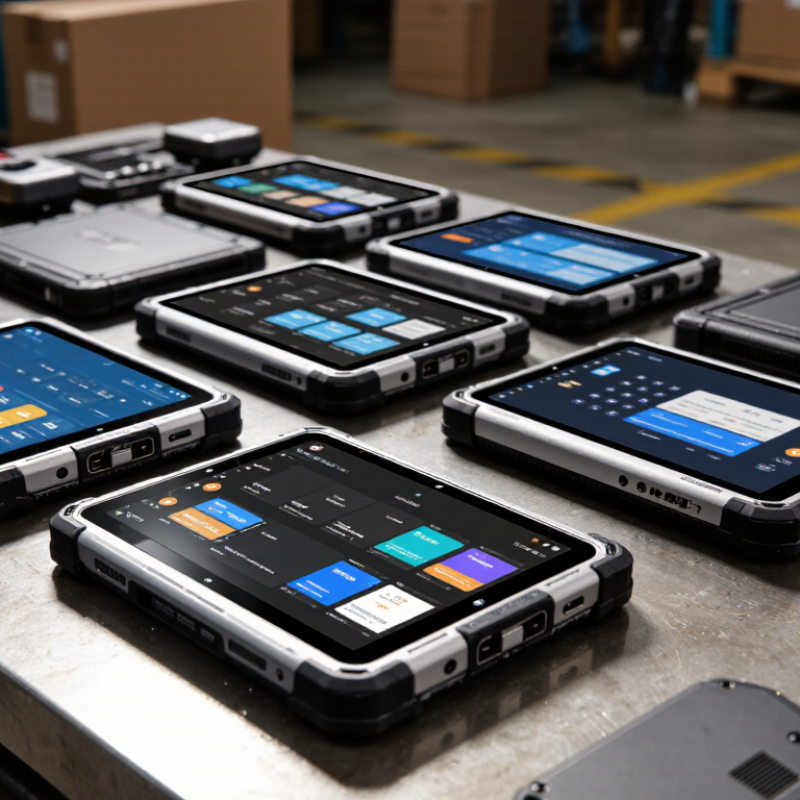
A capable rugged tablet manufacturer does more than install Android and add a thick case. It develops hardware for dust, rain, vibration, drops, and temperature changes. Engineers should explain test methods, not only display attractive specifications. A meaningful ingress rating requires controlled testing and clear documentation. Real field experience matters, especially when tablets are used on construction sites, in warehouses, or inside moving vehicles.
Reliability begins with component selection. A manufacturer should evaluate screens, batteries, charging ports, cameras, and processors as one system. A bright display is useful under direct sunlight, but it may increase power consumption. Replaceable batteries can extend working hours, although they may add weight. These trade-offs need honest explanations. No device is indestructible. That point is often missed.
Professional manufacturers also provide secure firmware updates, device management support, repair procedures, and product traceability. They should offer testing records, warranty terms, and realistic production timelines. Android compatibility must be checked with scanners, sensors, enterprise applications, and wireless networks. A tablet that survives a drop but loses data during a software update is not truly dependable. This is where careful validation separates a manufacturer from a simple reseller. Even strong designs can reveal weaknesses after long field use, so feedback and redesign should remain part of the process.
China Top 10 Android Rugged Tablet PC Manufacturers?
Ranking China’s top ten rugged tablet manufacturers requires more than factory size or online visibility. IDC reported global tablet shipments of 147.6 million units in 2024, showing strong demand for field-ready devices. However, rugged products need deeper verification.
A practical ranking should assign 25% to durability testing, including IP65 or higher protection and MIL-STD-810H evidence. Product reliability matters. Another 20% should cover Android update support, security patches, and chipset stability. Manufacturing capacity, quality-control records, customization ability, and delivery consistency deserve 30%. The remaining 25% should measure certifications, overseas service, spare-part access, and documented customer experience. MarketsandMarkets projects continued growth in the rugged tablet market through 2029, making transparent evaluation increasingly important. Some suppliers claim high protection ratings without showing complete test reports. That weakness should reduce their score.
Tips: Request independent test documents, not only product brochures. Check drop-test videos, battery-cycle results, and screen readability under direct sunlight. Ask whether replacement batteries remain available after three years. A factory audit can reveal more than a polished website. I would also compare failure rates from real deployments, although reliable public data is limited. That limitation should be stated clearly. A perfect ranking is unrealistic. A repeatable scoring method is more trustworthy.
China’s top ten Android rugged tablet manufacturers are best assessed by evidence, not factory size alone. Grand View Research valued the global rugged tablet market at about US$1.6 billion in 2023, with steady growth expected through 2030. That demand reflects warehouses, public transport, utilities, and outdoor service teams.
The ten profiles in this selection represent different strengths. Some focus on eight-inch tablets with glove-friendly screens and barcode scanning. Others build ten-inch models with sunlight-readable displays, hot-swappable batteries, and vehicle docks. Several manufacturers emphasize IP65 or IP67 protection, while stronger engineering teams test against MIL-STD-810H conditions. Not every supplier handles these tests equally well. That matters.
Production experience is visible in small details. A sealed USB port should remain usable after repeated cleaning. A battery latch should not loosen inside a moving vehicle. Android update policies also deserve careful review. Market reports from VDC Research connect rugged device demand with mobile workforce productivity, but productivity depends on software support, not hardware alone. The strongest manufacturers usually provide SDKs, device-management tools, repair channels, and clear test documentation. Certifications should be verified through laboratory records, rather than copied product pages. This is where buyers often make mistakes. A low initial price may hide short support cycles, limited spare parts, or weak quality control. Profiles should therefore compare production history, customization capability, warranty response, and real deployment feedback. Service depth remains difficult to measure.
China Top 10 Android Rugged Tablet PC Manufacturers: Industry Applications and Standout Product Features
China’s leading ten Android rugged tablet manufacturers serve logistics, field service, public transport, construction, and warehouse operations. In these environments, tablets face dust, rain, vibration, gloves, and frequent drops. Grand View Research estimates the global rugged devices market will continue expanding through 2030, driven by industrial digitization and mobile workforce demand. However, market growth does not guarantee suitable equipment.
Warehouse teams often need bright displays, physical scan triggers, NFC, and programmable keys. Construction crews usually prioritize sunlight readability, loud speakers, replaceable batteries, and precise positioning. In transport operations, 4G or 5G connectivity, GPS accuracy, and vehicle charging docks matter more. A tablet rated IP65 or IP67 may resist water and dust, while MIL-STD-810H testing indicates resistance to selected environmental stresses. These ratings are useful, but they do not replace field trials.
Android enterprise support is another purchasing concern. IDC’s enterprise mobility research consistently links device lifecycle management with lower operational disruption. Buyers should check update policies, mobile device management compatibility, encryption, and repair access. Hot-swappable batteries can protect long shifts. That feature is practical. Yet many specifications look impressive until workers use thick gloves or operate under direct sunlight. In my experience, poorly placed ports and weak charging connectors cause more downtime than small processor differences. Some evaluations also overlook weight, which becomes painful after eight hours. The strongest manufacturers therefore balance protection, usability, serviceability, and verified application performance rather than relying only on laboratory figures.
| Rank | Manufacturer Profile | Typical Screen Configuration | Android Platform | Ruggedization Characteristics | Connectivity Options | Power and Expansion | Primary Industry Applications | Standout Product Features |
|---|---|---|---|---|---|---|---|---|
| 1 | Profile 01 High-volume field use | 8-inch display 1,920 × 1,200 resolution 10-point capacitive touch | Android 13 or later Google Mobile Services available on selected configurations | IP68 protection MIL-STD-810H testing Drop resistance typically up to 1.5 m | Wi-Fi 6 5G or 4G LTE Bluetooth 5.x Optional NFC | Approximately 5,000–8,000 mAh battery USB-C charging Optional pogo-pin docking | Field service, public safety, transportation, warehouse operations | Compact one-hand design, glove-compatible touch, programmable keys, integrated camera and barcode-scanning support |
| 2 | Profile 02 Large-screen logistics | 10.1-inch display 1,920 × 1,200 resolution High-brightness panel | Android 12 or later Enterprise mobility management support | IP66 or IP67 protection MIL-STD-810H compliance Reinforced corners and chassis | Wi-Fi 6 4G LTE Bluetooth 5.1 GNSS | Approximately 8,000–10,000 mAh battery Hot-swappable option on selected models | Distribution centers, manufacturing, inventory control, fleet management | Wide viewing area, desktop-style docking, long-shift battery capacity, optional vehicle-mount accessories |
| 3 | Profile 03 Industrial inspection | 8-inch display 1,280 × 800 or 1,920 × 1,200 resolution Sunlight-readable options | Android 11–13 Long-term security-update options | IP65 or IP67 protection MIL-STD-810G/H testing Operating temperature commonly from -20°C to 55°C | Wi-Fi 5/6 4G LTE Bluetooth Optional dual-frequency GNSS | Approximately 6,000–8,000 mAh battery Replaceable battery on selected configurations | Utilities, oil and gas inspection, construction, asset maintenance | Readable outdoor display, physical navigation buttons, hand strap, serial-interface and Ethernet-dock options |
| 4 | Profile 04 Barcode-centric workflow | 7–8-inch display 1,280 × 800 resolution Glove and wet-touch support | Android 10–12 Dedicated enterprise scanning APIs | IP65 protection 1.2–1.5 m drop resistance Multiple-drop testing on selected devices | Wi-Fi 5 4G LTE Bluetooth 5.0 NFC | Approximately 4,500–7,000 mAh battery Charging cradle and spare-battery options | Retail replenishment, parcel handling, warehouse picking, cold-chain logistics | Integrated 1D/2D barcode engine, trigger buttons, scan aiming light, wrist strap and charging cradle ecosystem |
| 5 | Profile 05 Heavy-duty industrial | 10.1-inch display 1,920 × 1,200 resolution High-luminance touch panel | Android 12 or later Android Enterprise enrollment support | IP68 protection MIL-STD-810H testing Resistance to vibration, dust and water immersion | Wi-Fi 6 5G or 4G LTE Bluetooth 5.2 Multi-constellation GNSS | Approximately 8,000–10,000 mAh battery USB-C and pogo-pin charging Optional expansion module | Mining, energy, industrial automation, outdoor engineering | High-brightness display, rugged I/O covers, glove operation, optional UHF RFID or professional barcode expansion |
| 6 | Profile 06 Vehicle and transport | 8-inch display 1,280 × 800 or 1,920 × 1,200 resolution Anti-glare treatment | Android 11–13 Managed kiosk-mode support | IP65 or IP67 protection MIL-STD-810G/H testing Shock and vibration resistance | Wi-Fi 6 4G LTE Bluetooth GNSS with optional high-accuracy positioning | Approximately 6,000–8,000 mAh battery Vehicle dock with ignition control Optional RAM-mount compatibility | Public transport, delivery fleets, field dispatch, municipal services | Vehicle docking, external antenna support, ignition sensing, charging while mounted and programmable function keys |
| 7 | Profile 07 RFID-enabled operations | 10.1-inch display 1,920 × 1,200 resolution Capacitive multi-touch | Android 12 or later Application programming interface for RFID workflows | IP65 or IP66 protection MIL-STD-810H testing Reinforced housing | Wi-Fi 6 4G LTE or 5G Bluetooth 5.1 NFC and GNSS | Approximately 8,000 mAh battery USB-C fast charging Optional UHF RFID sled or integrated reader | Apparel inventory, retail stocktaking, warehouse asset tracking, library management | Long-range UHF RFID compatibility, large inventory screen, configurable scan controls and batch-data processing |
| 8 | Profile 08 Cost-efficient deployment | 8-inch display 1,280 × 800 resolution Brightness commonly above 500 nits | Android 10–12 Centralized device-management support | IP65 protection 1.2 m drop resistance Basic MIL-STD environmental testing | Dual-band Wi-Fi 4G LTE Bluetooth 5.0 Optional NFC | Approximately 5,000–7,000 mAh battery USB-C port Optional desktop charging dock | Education, hospitality, light warehouse work, service dispatch | Low total cost of ownership, lightweight chassis, replaceable protective frame and flexible cellular configurations |
| 9 | Profile 09 Outdoor mapping | 8–10.1-inch display 1,920 × 1,200 resolution Sunlight-readable and wet-touch options | Android 13 or later Support for GIS and surveying applications | IP67 or IP68 protection MIL-STD-810H testing Operating temperature commonly from -20°C to 60°C | Wi-Fi 6 5G or 4G LTE Bluetooth 5.2 Multi-band GNSS | Approximately 7,000–10,000 mAh battery Replaceable battery option USB-C and docking contacts | Surveying, forestry, agriculture, environmental monitoring, emergency response | High-accuracy positioning support, electronic compass, sunlight readability, external GNSS antenna and field-port accessories |
| 10 | Profile 10 Specialized healthcare | 10.1-inch display 1,920 × 1,200 resolution Easy-clean touch surface | Android 12 or later Enterprise security and kiosk-mode options | IP65 protection Drop-resistant enclosure Disinfectant-resistant housing on selected models | Wi-Fi 6 4G LTE Bluetooth 5.1 NFC | Approximately 7,000–9,000 mAh battery Hot-swap or charging-cart compatibility USB-C connectivity | Hospitals, laboratories, nursing facilities, medical asset management | Antimicrobial or cleanable enclosure options, barcode scanning, privacy-screen compatibility and hands-free workstation docking |
Choosing a Chinese rugged tablet manufacturer requires more than comparing prices. MarketsandMarkets estimates the global rugged tablet market could grow from about USD 1.6 billion in 2023 to USD 2.4 billion by 2028. Demand is rising in logistics, field service, warehousing, and public infrastructure. That growth also attracts inexperienced suppliers.
Request verifiable evidence before selecting a factory. Ask for IP65 or IP67 test reports, drop-test records, battery safety documents, and ISO 9001 certification. Check whether the reports match the exact model, not a similar sample. A reliable manufacturer should explain operating temperature, screen brightness, glove support, charging cycles, and repair procedures clearly. VDC Research notes that rugged-device buyers increasingly value lifecycle support, not only hardware durability.
Review the production process in detail. Can the factory provide a stable Android update policy? Are spare batteries available after three years? How quickly can it replace a damaged charging port? Small details matter. Request ten to twenty pilot units and test them in dust, rain, sunlight, and vehicle vibration. Do not trust a short laboratory demonstration alone. MarketsandMarkets and other research firms report different market sizes, partly because product definitions vary. That is worth remembering when a supplier presents impressive market claims. My own selection mistake would be judging durability from appearance; a thick shell can still hide weak connectors, poor thermal design, or inconsistent quality control.
Use this practical procurement weighting to compare manufacturers without relying on brand popularity or company-specific data. The percentages represent recommended evaluation priorities for industrial, logistics, construction, and field-service tablet projects.
A suitable manufacturer should provide documented test results, configurable hardware, stable Android support, dependable after-sales service, and compliance documentation for the target market.
Our mission is to develop cutting-edge clean energy technology and provide next-generation solar inverters.
(888) 598-9901
nep-usa@site_ea168614-f5f4-4298-bd5b-880b4cf8d99d