- Spanish-Latin America
- Japanese-JP
- Chinese
- Europe
- Português-BR

Tech Support
(888) 598-9901
Hours: Mon-Fri 8AM-8PM EST
nep-usa@site_ea168614-f5f4-4298-bd5b-880b4cf8d99d
7 Tips for Choosing a Pipe Ring Bending Machine?
Choosing the right Pipe Ring Bending Machine can shape production quality, operating costs, and customer satisfaction. A machine may look powerful on a brochure, yet struggle with thin-wall tubing, tight radii, or repeated ring sizes. The real test appears on the shop floor.
Jeffrey K. Liker, a respected manufacturing expert, states, “The right process will produce the right results.” This principle applies directly to pipe ring bending. Buyers should examine bending capacity, material compatibility, tooling flexibility, control accuracy, and production speed. Safety features and after-sales support also deserve close attention. A reliable supplier should explain these details clearly, not hide them behind impressive specifications.
Start with the pipe diameter and wall thickness. Then compare the required ring diameter, bending radius, and daily production volume. Ask for sample-bending tests using your actual material. Watch for wrinkles, flattening, springback, and uneven joints. Small defects become expensive when hundreds of rings leave the line.
Cost matters, but the cheapest option may create costly rework. That is easy to underestimate. Energy use, changeover time, spare-part availability, and operator training influence the long-term value of a Pipe Ring Bending Machine. Buyers should also inspect the machine’s frame, drive system, emergency controls, and software interface.
No selection method is perfect. Production conditions change. Your first assumptions may be incomplete. These seven practical tips provide a clearer path toward a machine that fits present needs and future capacity.
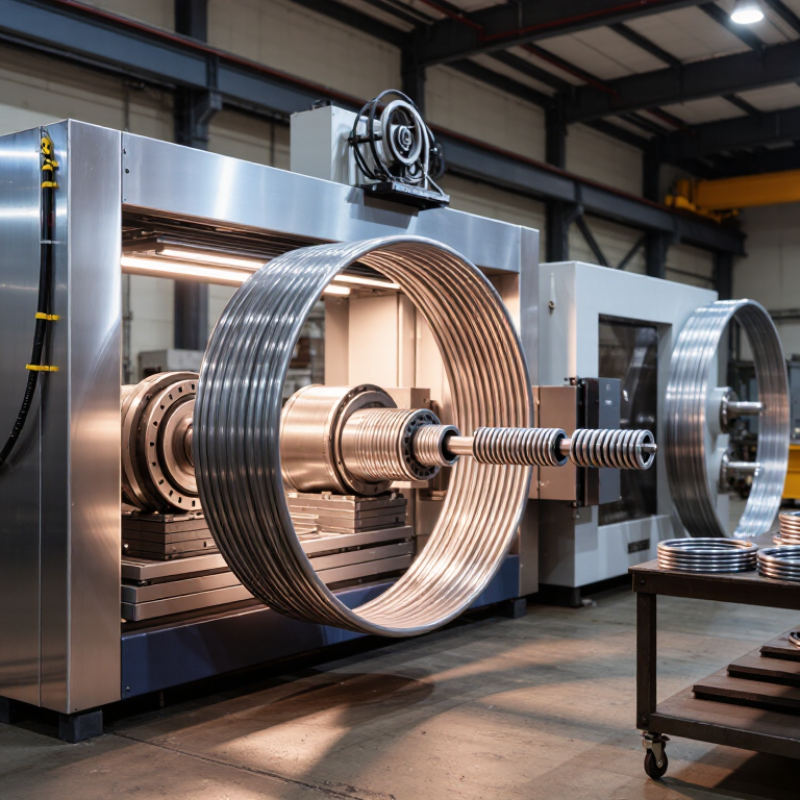
Define the Pipe Sizes and Materials the Machine Must Handle
Define the Pipe Sizes and Materials the Machine Must Handle
Start with actual production data, not an attractive machine brochure. Record each pipe’s outside diameter, wall thickness, length, bend angle, and required centerline radius. ASME B36.10M covers welded and seamless carbon-steel pipe dimensions from NPS 1/8 to NPS 80. ASME B36.19M covers stainless-steel pipe dimensions. These ranges are broad, but one machine rarely handles every size efficiently.
Material changes the bending equation. Carbon steel, stainless steel, aluminum, and copper need different force, tooling, and speed settings. The World Steel Association reported 1.89 billion tonnes of global crude steel production in 2023. That volume reflects steel’s importance, not identical forming behavior. Check the grade, yield strength, elongation, and work-hardening tendency. A thin stainless tube may wrinkle before a thicker carbon-steel pipe reaches its target radius. It happens.
Ask suppliers for verified capacity charts. Confirm the maximum outside diameter and wall thickness together, because capacity often falls when both increase. Request sample bends using your exact material and dimensions. Measure ovality, wall thinning, surface marks, and springback afterward. ASTM A513 tubing and ASTM A312 stainless pipe should not be treated as interchangeable, even when their nominal sizes appear similar. I have seen size lists hide this problem. Your production records should drive the specification, with a small allowance for future sizes.
Get in touch
Our mission is to develop cutting-edge clean energy technology and provide next-generation solar inverters.
Phone
(888) 598-9901
nep-usa@site_ea168614-f5f4-4298-bd5b-880b4cf8d99d
