- Spanish-Latin America
- Japanese-JP
- Chinese
- Europe
- Português-BR

Tech Support
(888) 598-9901
Hours: Mon-Fri 8AM-8PM EST
nep-usa@site_ea168614-f5f4-4298-bd5b-880b4cf8d99d
How to Choose the Best Street Outdoor Light in 2026?
Choosing the best Street Outdoor Light in 2026 means balancing visibility, energy use, maintenance, and comfort—not simply buying the brightest fixture. A road should feel clear, not harsh. Drivers need to see the pavement, pedestrians, and crossing points, while nearby homes should not receive unwanted glare. The Illuminating Engineering Society’s ANSI/IES RP-8-22 provides recommended practices for roadway and street lighting, including guidance on lighting levels and uniformity. It is a useful technical reference, but local conditions still matter.
Efficiency deserves a closer look. The U.S. Department of Energy’s Energy Saver guidance reports that LEDs use at least 75% less energy and last up to 25 times longer than incandescent lighting. That comparison is not a direct forecast for replacing every streetlight; existing fixtures and operating schedules vary. Still, it highlights why buyers should compare measured luminaire efficacy, expected service life, and control options—not wattage alone. Ask for photometric files, glare-control details, color-temperature data, and a clear warranty. Small details count.
Human impact matters, too. Dr. Mariana Figueiro, a researcher in lighting and health, has described light as “the most powerful synchronizer of the circadian system.” Her work concerns light and human rhythms, not a one-size-fits-all streetlight specification. Use it as a reminder to consider timing, spectrum, and spill light alongside visibility. A good choice may cost more upfront. Sometimes the cheaper fixture is the expensive mistake. Compare real project data, and be willing to question confident claims.
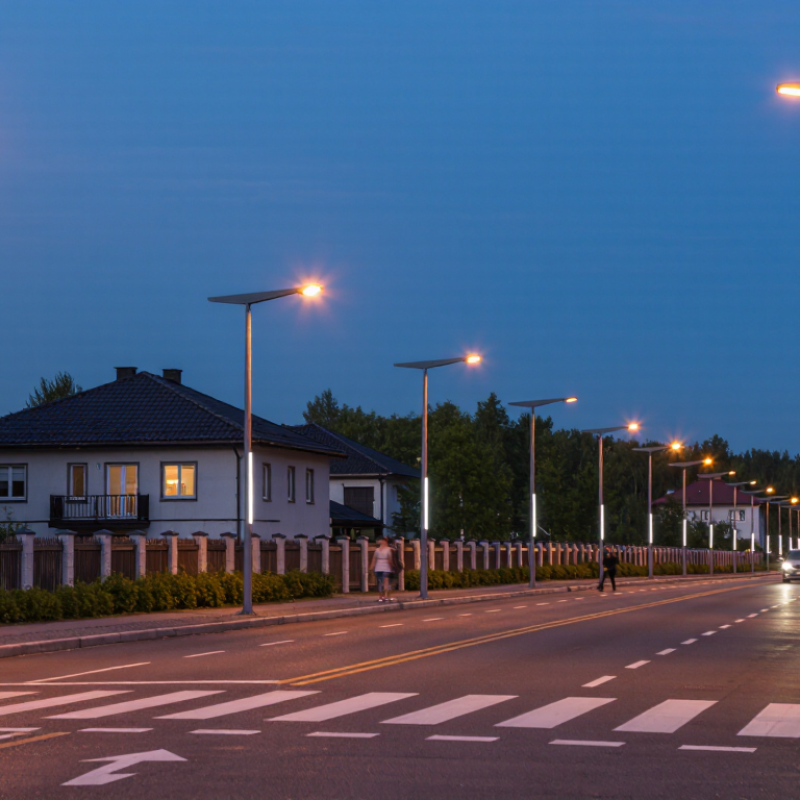
Define the Lighting Needs of the Street and Surrounding Area
Define the street before selecting a fixture. A residential lane with parked cars, mature trees, and slow traffic needs a different lighting plan from a wide arterial with bus stops and turning lanes. Map crossings, driveways, sidewalks, and places where people wait. NHTSA’s Traffic Safety Facts: Pedestrians, 2022 Data reports that roughly three-quarters of pedestrian fatalities occurred in dark conditions. That is a reason to assess visibility at conflict points, not simply brighten every block.
Record road width, surface condition, traffic speed, pedestrian activity, and nearby windows or habitat. Then check the applicable lighting class and design criteria in ANSI/IES RP-8-22, Recommended Practice: Lighting Roadway and Parking Facilities. The plan should consider light levels, uniformity, glare, and spill beyond the roadway. Averages can hide dark patches. Walk the route after dark, too; wet pavement and tree canopies may change what the calculations suggest.
Tips: Photograph crossings and corners at night. Note where faces, curbs, and signs become hard to see. Include residents’ concerns about glare, but verify them on site. A tidy pole layout may still leave one awkward shadow. Recheck before finalizing.
Get in touch
Our mission is to develop cutting-edge clean energy technology and provide next-generation solar inverters.
Phone
(888) 598-9901
nep-usa@site_ea168614-f5f4-4298-bd5b-880b4cf8d99d
