- Spanish-Latin America
- Japanese-JP
- Chinese
- Europe
- Português-BR

Tech Support
(888) 598-9901
Hours: Mon-Fri 8AM-8PM EST
nep-usa@site_ea168614-f5f4-4298-bd5b-880b4cf8d99d
How to Choose a Fufu Mixer Machine in 2026?
Choosing a Fufu Mixer Machine in 2026 involves more than comparing motor power or price. The machine must handle the actual texture, batch size, and working rhythm of your kitchen or production site. FAO’s report Save and Grow: Cassava (2013) notes that cassava is a staple food for more than 800 million people worldwide. That scale makes reliable processing important, but it does not mean every mixer suits every fufu recipe. A machine that works well with one cooked cassava blend may struggle with a thicker yam mixture.
Start with the details you can observe. How many kilograms will you process per batch? Does the bowl allow you to inspect the mixture without stopping? Can the paddles reach its edges? These practical checks matter. So do cleaning access, spare-part availability, and the manufacturer’s stated duty cycle. FAO and WHO’s Codex General Principles of Food Hygiene (CXC 1-1969, revised 2022) provide a useful reference for hygienic food handling and equipment design. Ask suppliers how their machine’s food-contact surfaces can be cleaned and maintained. Then request a demonstration using your ingredients, not just an empty-bowl test.
Be cautious with dramatic capacity claims. Published specifications may not reflect your recipe, operator skill, or power supply. There is no single performance figure that proves a Fufu Mixer Machine is right for every buyer. A short trial can reveal awkward controls, uneven mixing, or cleanup problems that a brochure misses. Some uncertainty remains; that is a reason to verify, not guess.
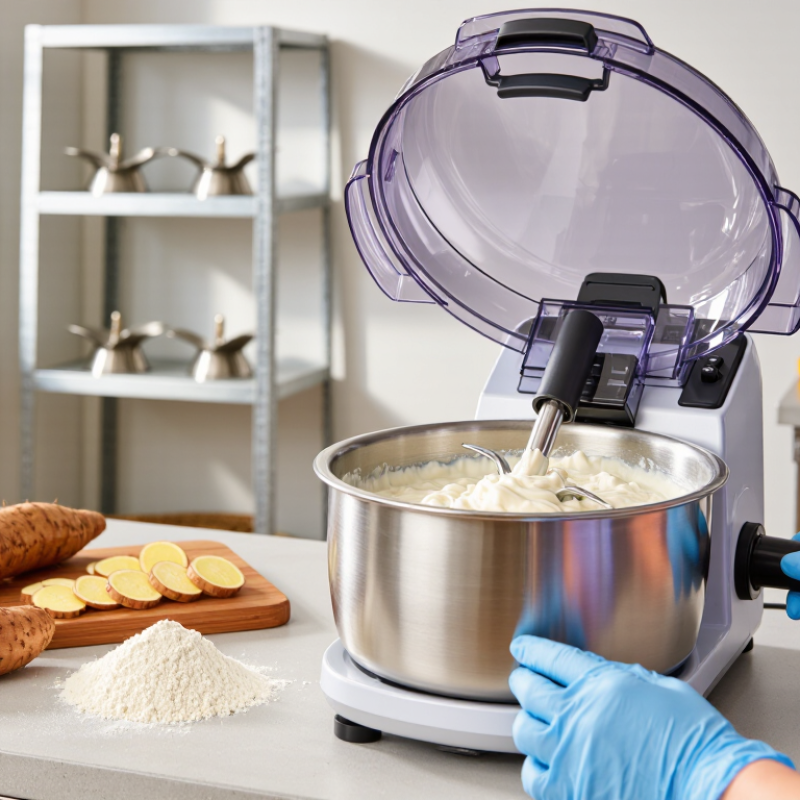
Identify Fufu Type, Daily Output (kg/h), and Batch Size (kg)
Choose a mixer around the fufu you actually make, not a generic capacity label. Fermented cassava mash, cooked cassava, and plantain blends behave differently under mixing. Fresh cassava also carries substantial water. FAO’s Roots, Tubers, Plantains and Bananas in Human Nutrition reports that cassava roots typically contain about 60–70% moisture. That changes the weight and texture entering the mixer. Texture matters. Ask suppliers to test your own ingredients and document the resulting consistency, mixing time, and usable batch weight.
Calculate hourly output from your daily target and available production hours. If you need 480 kg in six operating hours, the line must average 80 kg per hour, including normal pauses. An eight-hour shift rarely means eight hours of mixing. Allow time for loading, unloading, cleaning, and changeovers. FAOSTAT records more than 330 million tonnes of global cassava production in 2022, but that broad crop figure cannot predict a local plant’s demand. Treat rated throughput as a starting point, not a promise. Run a trial. Record how a half-full batch compares with a full one; the result may be less even than expected.
Get in touch
Our mission is to develop cutting-edge clean energy technology and provide next-generation solar inverters.
Phone
(888) 598-9901
nep-usa@site_ea168614-f5f4-4298-bd5b-880b4cf8d99d
