- Spanish-Latin America
- Japanese-JP
- Chinese
- Europe
- Português-BR

Tech Support
(888) 598-9901
Hours: Mon-Fri 8AM-8PM EST
nep-usa@site_ea168614-f5f4-4298-bd5b-880b4cf8d99d
How to Choose the Right J1772 Charging Station?
Choosing a J1772 charging station is not just a matter of buying the highest-powered unit. The right choice depends on your vehicle, electrical supply, parking setup, and daily charging routine. The International Energy Agency reported that public charging points worldwide exceeded four million in 2023, with their number growing by about 40% that year (IEA, Global EV Outlook 2024). That expansion makes home charging equipment easier to compare, but it also leaves buyers facing crowded specifications and uneven installation needs.
J1772 is a widely used AC charging connector in North America, and SAE standards define its charging interface. Before comparing models, check your vehicle’s connector requirements and maximum AC charging rate. Then look at the station’s amperage, circuit needs, cable reach, weather protection, and warranty. A long cable can reach a driveway-side port more comfortably. A hardwired unit may suit one installation, while a plug-in model may offer more flexibility. Small details matter.
A bigger number is not always better. A 48-amp station, for example, cannot deliver its full output unless the home circuit and vehicle support it. Smart scheduling and energy tracking can help, but only if you will use them. Installation costs deserve attention, too; they can change the value of an otherwise attractive J1772 charging station. Treat product claims as a starting point, not a guarantee. The best fit is often less dramatic than the spec sheet suggests.
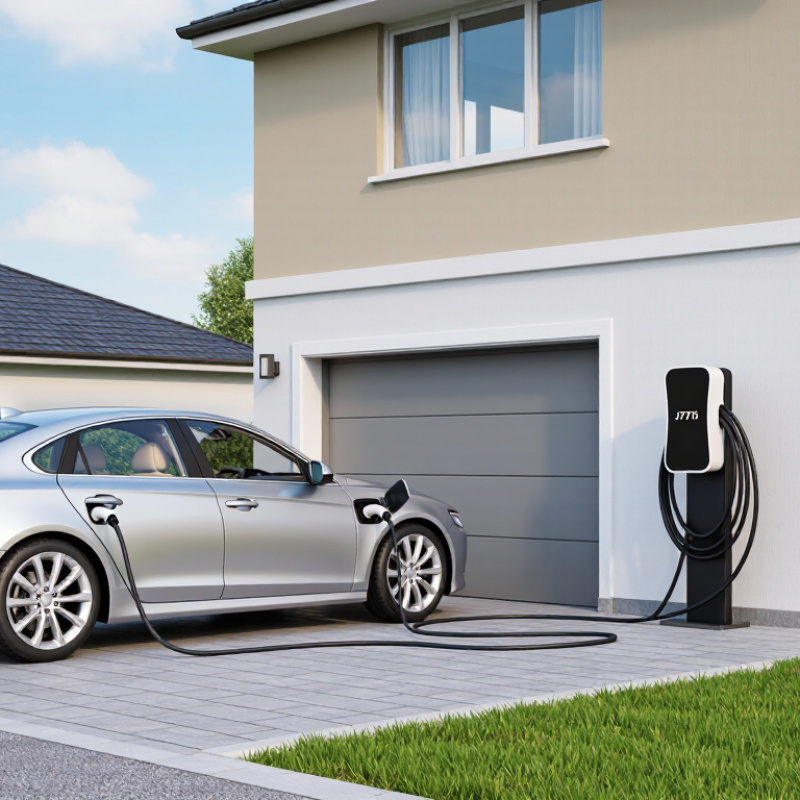
Understanding J1772 Charging Standards and Connector Types
J1772 is a widely used AC charging standard in North America. It describes how a compatible vehicle and charging station connect and communicate. Level 1 charging typically uses a 120-volt supply, while Level 2 commonly uses 208 or 240 volts. The plug has five contacts: two carry AC power, one provides grounding, and two support safety and communication signals. The vehicle’s onboard charger converts AC power for the battery, so charging speed also depends on the vehicle, not just the station.
Connector details matter. A J1772 inlet accepts the matching AC plug, while some vehicles use a combined inlet with extra contacts for DC fast charging. Those extra contacts belong to a separate charging setup; a standard J1772 plug alone does not provide DC fast charging. I still find connector names confusing at a glance. Check the vehicle manual and inlet shape before choosing equipment, and confirm the station’s voltage and amperage are suitable for the vehicle and installation.
Tips: Match the connector to your vehicle’s inlet. Check the station’s rated output and your vehicle’s AC charging limit. Look for a secure latch and an undamaged cable before plugging in. Small details are easy to miss.
Get in touch
Our mission is to develop cutting-edge clean energy technology and provide next-generation solar inverters.
Phone
(888) 598-9901
nep-usa@site_ea168614-f5f4-4298-bd5b-880b4cf8d99d
