We use our own and third-party cookies to improve our services. If you continue browsing, we will consider that you accept this use. Read More

OK

English-US
  • Spanish-Latin America
  • Japanese-JP
  • Chinese
  • Europe
  • Português-BR

Tech Support

(888) 598-9901
Hours: Mon-Fri 8AM-8PM EST

E-mail

nep-usa@site_ea168614-f5f4-4298-bd5b-880b4cf8d99d

How to Choose the Right 5G Components for Global Sourcing?

Choosing the right 5g Component for global sourcing requires more than comparing prices and data sheets. It demands field experience, technical discipline, and careful supplier verification.

Cristiano Amon, Qualcomm’s President and CEO, has said, “5G is going to be as transformational as electricity.” His statement reflects the wider responsibility of component selection. A weak module can affect an entire product line. Delayed certification can also stop shipments at the border.

A reliable sourcing process begins with the application. Define frequency bands, output power, thermal limits, antenna interfaces, and expected operating conditions. A component tested in a quiet laboratory may behave differently inside a crowded industrial enclosure. That difference matters.

Check the supplier’s production history. Review test reports, failure data, traceability procedures, and change-control policies. Confirm whether the manufacturer supports regional certifications and long-term software updates. These details often separate a dependable 5g Component from a cheaper substitute.

Global projects also need supply resilience. Compare approved factories, component availability, lead times, and logistics routes. Ask how the supplier handles shortages. The answer may reveal more than a polished presentation.

Do not trust one impressive sample.

An experienced engineer should test several production units, not only evaluation boards. Measure performance across temperature, vibration, power fluctuations, and network conditions. Document every result. Small gaps can become expensive failures.

There is no perfect sourcing decision. I have seen technically excellent components lose value because documentation arrived late. I have also seen lower-cost parts require excessive integration work. The right choice balances performance, compliance, continuity, and real-world support. That balance deserves careful questioning before any purchase order is approved.
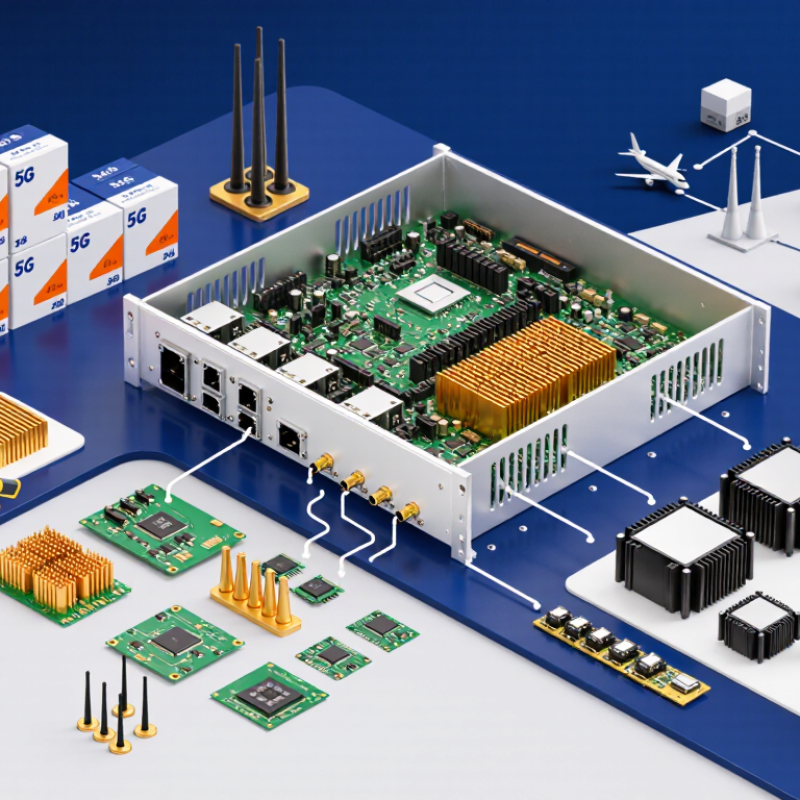
How to Choose the Right 5G Components for Global Sourcing?

Define the Performance and Deployment Requirements for 5G Components

When sourcing 5G components globally, define the operating job before comparing prices. State target frequency bands, channel bandwidth, peak and sustained throughput, latency, and connection density. “High speed” is not a usable requirement. A warehouse sensor may need low power and stable coverage, not extreme download rates. Write measurable limits, such as sub-10-millisecond latency under a defined load. Be precise. Ambiguity becomes expensive during integration.

Deployment requirements should describe the real installation, not an ideal laboratory. Record ambient temperature, humidity, vibration, enclosure rating, antenna placement, available power, and backhaul limits. Check whether the component supports required network modes and regional frequency allocations. Ask for test reports, calibration records, firmware lifecycle policies, and traceable production data. Independent validation matters. Supplier declarations alone may not reveal thermal throttling or packet loss.

Build a test plan using traffic patterns from the intended site. Measure performance after warm-up, during congestion, and across temperature changes. Include failover, recovery time, and remote-management behavior. A pilot shipment can expose connector tolerances or installation mistakes early. Do not trust peak figures. They are often polished. I have seen teams over-specify radio performance while ignoring power budgets and technician access. That mistake is avoidable, though field assumptions can still be wrong. Revisit requirements after the first deployment and document every deviation before scaling procurement.

Match Component Specifications to Network Architecture and Use Cases

Choosing a 5G component starts with the network architecture, not a catalog search. A standalone network may require different timing, processing, and interface capabilities than a non-standalone deployment. Sub-6 GHz designs often prioritize coverage and penetration, while mmWave systems demand precise antenna integration and thermal control. That difference changes the suitable radio module, filter, power amplifier, and cable assembly. Confirm supported bands, channel bandwidth, duplexing method, impedance, connector type, and operating voltage. Small mismatches can create expensive redesigns.

Use case should narrow the specification further. A factory robot needs stable latency, rugged housing, and predictable handover performance. A remote sensor may value low power, compact dimensions, and extended temperature tolerance.

For outdoor equipment, request ingress protection data, surge testing, and thermal-cycle results. Do not rely on a generic “5G-ready” label. Review antenna gain, receiver sensitivity, transmit power, synchronization accuracy, and software compatibility against the actual deployment map.

Then test production samples in a chamber and on the intended cable length.

Global sourcing adds regional constraints. A component can meet the radio specification yet fail local frequency rules, safety requirements, or import documentation checks. Ask suppliers for traceable test reports, revision history, material declarations, and a clear change-notification process.

Also compare lifecycle risk, not only unit price. A low-cost module becomes expensive when firmware support ends early. I have seen clean spreadsheets hide connector losses and heat buildup near sealed enclosures. Leave margin for tolerance, aging, and imperfect installation. Record those limits before requesting volume quotations.

Evaluate Supplier Quality, Certifications, and Regional Compliance

Choosing 5G components for global sourcing requires more than comparing unit prices. Supplier quality should be visible in records, processes, and test results. During a supplier review, request production samples from the actual factory, not only showroom units. Check connector fit, thermal behavior, signal loss, and housing durability. Ask how each lot is identified and traced. Documents are not enough. A stable supplier can explain rejected batches, corrective actions, and engineering changes without vague answers.

Certifications need careful verification. Confirm the certificate holder, product scope, testing laboratory, issue date, and expiration status. ISO 9001 may indicate controlled quality processes, while ISO/IEC 17025 accreditation supports confidence in laboratory measurements. These certificates do not automatically approve every component. Request test reports for the exact model and revision. I once treated a valid-looking report as final evidence, but its frequency range did not match the target module. That mistake was avoidable. It also delayed qualification.

Regional compliance must match the destination market and product function. Review radio bands, electrical safety, electromagnetic compatibility, environmental restrictions, labeling, and import documentation. Requirements can change between regions, even when hardware looks identical. Ask the supplier for a compliance matrix with evidence beside every claim. Include sample labels and packaging photos. Have an independent engineer review unclear items. Supplier answers can be incomplete. That is normal, but unverified assumptions are expensive. Build purchase terms around change notification, batch inspection, and access to updated records.

How to Choose the Right 5G Components for Global Sourcing? - Evaluate Supplier Quality, Certifications, and Regional Compliance

A practical sourcing matrix for evaluating 5G component categories, technical requirements, supplier-quality evidence, certification needs, and regional compliance before procurement.

Component Category Primary Function Key Technical Evaluation Dimensions Supplier Quality Evidence Relevant Standards and Certifications Regional Compliance Considerations Supply-Risk Priority Recommended Sourcing Check
5G Radio Modules Provide cellular connectivity for industrial, automotive, medical, and enterprise equipment. 3GPP release support NSA/SA operation Sub-6 GHz or mmWave bands Throughput and latency Operating temperature ISO 9001 certificate; controlled firmware-revision process; production test records; failure-rate data; lot traceability; documented change-notification procedure. 3GPP 5G NR specifications; ISO/IEC 17025-accredited RF testing; IEC 62368-1 where incorporated into information and communication technology equipment; applicable radio-equipment approvals. EU: Radio Equipment Directive 2014/53/EU; United Kingdom: Radio Equipment Regulations; United States: FCC equipment authorization; Canada: ISED RSS requirements; Japan: Radio Law certification; China: SRRC approval; India: WPC/ETA requirements may apply. High Require a country-and-band approval matrix, test reports for the exact hardware and firmware version, and written notice of material changes.
RF Front-End Modules Filter, amplify, switch, and route radio-frequency signals between the transceiver and antenna. Insertion loss Noise figure Output power Linearity Band isolation Automated test coverage; calibration records; incoming-material inspection; process capability data; counterfeit-component controls; component traceability. Applicable 3GPP RF performance requirements; JEDEC-based semiconductor handling practices where relevant; ISO 9001; ISO/IEC 17025 laboratory reports for RF characterization. Verify operation across the target operator bands and regional spectrum allocations. Confirm that the finished radio remains within local conducted and radiated emission limits. High Compare datasheet limits with measured distribution data, not only typical values. Request temperature, voltage, and frequency corner results.
5G Antennas and Antenna Arrays Transmit and receive radio signals, including beamforming and multi-input multi-output operation. Frequency coverage Gain Efficiency Radiation pattern Isolation Specific absorption rate Accredited anechoic-chamber test reports; production tuning procedure; dimensional-control records; connector inspection; environmental and vibration test results. 3GPP antenna and radio-performance requirements as applicable; IEC/IEEE 62209 series for human-exposure assessment; ISO/IEC 17025 laboratory accreditation. Certification is normally assessed as part of the complete radio product. Human-exposure limits, installation configuration, antenna gain, and separation distance differ by jurisdiction. High Request test data for the final enclosure and cable arrangement. Do not approve an antenna using an isolated-component report only.
RF Filters, Duplexers, and Multiplexers Separate frequency bands and reduce interference between transmit and receive paths. Passband loss Stopband rejection Power handling Temperature drift Group delay Process-control charts; cavity or ceramic dimensional inspection; lot-level S-parameter testing; thermal-aging data; packaging and moisture-control records. 3GPP band-specific RF requirements; ISO 9001; ISO/IEC 17025 testing where independent verification is required. Confirm that the selected passbands match the legal operating bands in every destination market. Spectrum allocations and permitted bandwidths are not identical worldwide. Medium Use measured S-parameter files over temperature and production tolerance. Verify that substitute materials do not alter tuning.
Power Management ICs and DC-DC Converters Convert, regulate, sequence, and monitor power supplied to 5G processing and RF circuits. Efficiency Load transient response Output ripple Thermal performance Protection functions Semiconductor manufacturing traceability; electrical screening; accelerated-life or reliability data; counterfeit avoidance; change-control and end-of-life notification. IEC 62368-1 may apply at equipment level; IEC 61000-4 series is relevant to immunity testing of finished equipment; RoHS and REACH material declarations may be required. EU and United Kingdom substance restrictions require documentation for restricted substances. North American and Asian markets may impose additional energy, safety, or product-level requirements. High Validate worst-case thermal conditions, input transients, and conducted emissions in the final board design.
Baseband, Application, and Network Processors Execute protocol stacks, data processing, security functions, and application workloads. CPU/NPU performance Memory bandwidth Security support Long-term availability Software support Secure-development lifecycle evidence; software bill of materials; vulnerability-response process; silicon errata; product-lifecycle commitment; secure boot documentation. ISO/IEC 27001 can support information-security governance; ISO/IEC 62443 may be relevant to industrial cybersecurity; IEC 62443-4-1 addresses secure product development processes. Cybersecurity and data-protection obligations depend on the application and destination market. Critical infrastructure, connected vehicles, and medical devices may require additional sector-specific controls. High Assess security-update duration, vulnerability disclosure practices, export-control exposure, and software dependency management before approval.
High-Speed Connectors and RF Cables Provide controlled electrical and RF interconnections between modules, boards, antennas, and test interfaces. Impedance control Return loss Insertion loss Mating cycles Shielding effectiveness Dimensional inspection; crimp-force monitoring; continuity and hipot testing where applicable; material certificates; salt-spray and vibration results; lot traceability. IEC 60512 test methods may apply to electrical connectors; IEC 62368-1 may apply at equipment level; RoHS and REACH declarations are commonly requested. Check fire, smoke, halogen, and material requirements for the target equipment category. Cable assemblies may also require local labeling and safety documentation. Medium Require test data for the complete cable assembly, including connector, cable length, bend radius, and mating configuration.
Thermal Interface Materials and Cooling Assemblies Transfer heat away from processors, RF amplifiers, and power devices to maintain operating limits. Thermal conductivity Thermal resistance Compression set Outgassing Aging stability Batch viscosity or thickness records; thermal-impedance testing; shelf-life controls; material safety data; reliability testing under temperature and humidity cycling. IEC 60068 environmental test methods may be used for temperature, humidity, vibration, and shock evaluation; UL-recognized material data may be requested for safety-critical assemblies. Confirm chemical-substance declarations, flammability requirements, and transport documentation. Requirements vary with enclosure, installation environment, and end-product category. Medium Evaluate thermal performance after aging and compression, not only the initial supplier datasheet value.
Enclosures, Shielding Cans, and EMI Materials Protect electronics from mechanical damage, electromagnetic interference, moisture, and environmental exposure. Shielding effectiveness Ingress protection Mechanical strength Surface finish Dimensional stability First-article inspection; coating-thickness records; environmental aging; ingress testing; dimensional capability studies; tooling and revision control. IEC 60529 may apply to IP-rated enclosures; IEC 61000-4 series supports EMC immunity testing; IEC 62368-1 may apply to the finished equipment. Final-product EMC, safety, and ingress claims must be verified using the production enclosure. Local marking and recycling obligations may apply. Medium Freeze the mechanical interface and coating specification before sourcing. Re-test after tooling, plating, or material changes.

Verify Interoperability, Security, and Global Frequency Compatibility

Choosing 5G components for global sourcing starts with frequency compatibility, not price. GSMA Intelligence reported 1.6 billion 5G connections at the end of 2023, with adoption projected to reach 56% of mobile connections by 2030. This scale creates regional complexity. Check supported bands, duplex modes, and carrier aggregation carefully. A radio tuned for n78 may not cover another market’s low-band requirements. Verify n41, n77, n78, and local sub-1 GHz bands against official allocation tables. Filters, antennas, and power amplifiers must match the modem’s band plan.

Interoperability needs laboratory evidence. Confirm 3GPP release support, standalone and non-standalone operation, VoLTE or VoNR behavior, roaming profiles, and fallback procedures. Run certification tests before large orders. Test weak signals, handovers, dual-SIM operation, and carrier aggregation with real network configurations. 3GPP TS 33.501 defines the 5G security architecture, including subscriber protection and authentication controls. Secure boot, signed firmware, hardware key storage, update rollback, and a documented vulnerability process should be verified. ENISA’s 5G Threat Landscape highlights risks across supply chains, virtualization, and signaling systems.

The spreadsheet is not enough. A common sourcing mistake is trusting a “global” label without checking regional firmware and antenna variants. Ask for conformance reports, SAR results, software bills of materials, and failure-rate data. Then repeat testing after firmware changes. Small revisions can break compatibility. This part is often underestimated.

Compare Total Costs, Logistics, Support, and Supply Continuity

Choosing 5G components globally requires more than comparing unit prices. GSMA Intelligence forecasts 5.5 billion 5G connections by 2030, increasing pressure on reliable sourcing. A cheaper module may create higher costs through certification, rework, inventory, and field support. Calculate total landed cost, including freight, insurance, testing, duties, integration, and replacement stock.

Logistics performance deserves close attention. The World Bank’s 2023 Logistics Performance Index evaluates customs, infrastructure, shipment quality, tracking, and delivery timeliness. These factors can affect production more than a small price difference. UNCTAD reports that maritime transport carries over 80% of global merchandise trade, so port congestion or route disruption can quickly delay components. Ask suppliers for realistic lead times, regional warehouses, packaging specifications, and documented alternate routes. Paper promises are not enough.

Support quality is often overlooked. Check firmware maintenance, technical response times, failure-analysis procedures, and documentation language before signing. Supply continuity needs evidence, such as multi-site production, approved substitute components, and transparent allocation policies. Ericsson’s Mobility Report projected nearly 6.3 billion 5G subscriptions by 2029, showing why demand planning matters. However, forecasts can change. My own sourcing mistake was treating forecast volume as guaranteed demand. A staged purchase plan, buffer stock, and quarterly risk review would have reduced that exposure. The perfect supplier does not exist. Evaluate the complete operating picture.

How to Choose the Right 5G Components for Global Sourcing?

Compare total costs, logistics, technical support, and supply continuity across common 5G component categories.

How to read the chart: Scores are normalized to a 100-point sourcing benchmark, where higher values indicate a more favorable result. The assessment combines landed-cost control, delivery predictability, engineering support, and supply-continuity risk. A weighted evaluation should be completed using each buyer’s forecast volume, qualification requirements, and regional inventory strategy.

Get in touch

Our mission is to develop cutting-edge clean energy technology and provide next-generation solar inverters.

Phone

(888) 598-9901

E-mail

nep-usa@site_ea168614-f5f4-4298-bd5b-880b4cf8d99d
