- Spanish-Latin America
- Japanese-JP
- Chinese
- Europe
- Português-BR

Tech Support
(888) 598-9901
Hours: Mon-Fri 8AM-8PM EST
nep-usa@site_ea168614-f5f4-4298-bd5b-880b4cf8d99d
China Top 10 Advertising Flag Hardware Manufacturers?
Advertising flags look simple from a distance. Up close, their performance depends on precise hardware: a flexible pole, secure connectors, a stable base, and fabric that moves without tearing. This guide to China’s top 10 Advertising Flag Hardware manufacturers will help buyers compare suppliers beyond polished product photos.
The Outdoor Advertising Association of America reported that U.S. out-of-home advertising revenue reached a record $9.1 billion in 2023. This figure describes the wider advertising market, not flag hardware sales. Still, it shows why durable, visible display systems matter to brands and event teams. Hardware quality affects setup time, portability, wind response, and replacement costs. Small details count.
Advertising pioneer William Bernbach famously said, “Advertising is fundamentally persuasion and persuasion happens to be not a science, but an art.” For flag displays, that idea meets engineering: a clear message needs dependable equipment to stay visible. The companies featured here should be assessed on materials, product range, customization, quality controls, export experience, and documented customer feedback. Ask for specifications, sample testing, and warranty terms. A supplier’s claim is not proof.
There is no perfect ranking. Buyer needs differ, and public data on this niche remains limited. This overview offers a practical starting point—not a substitute for due diligence.
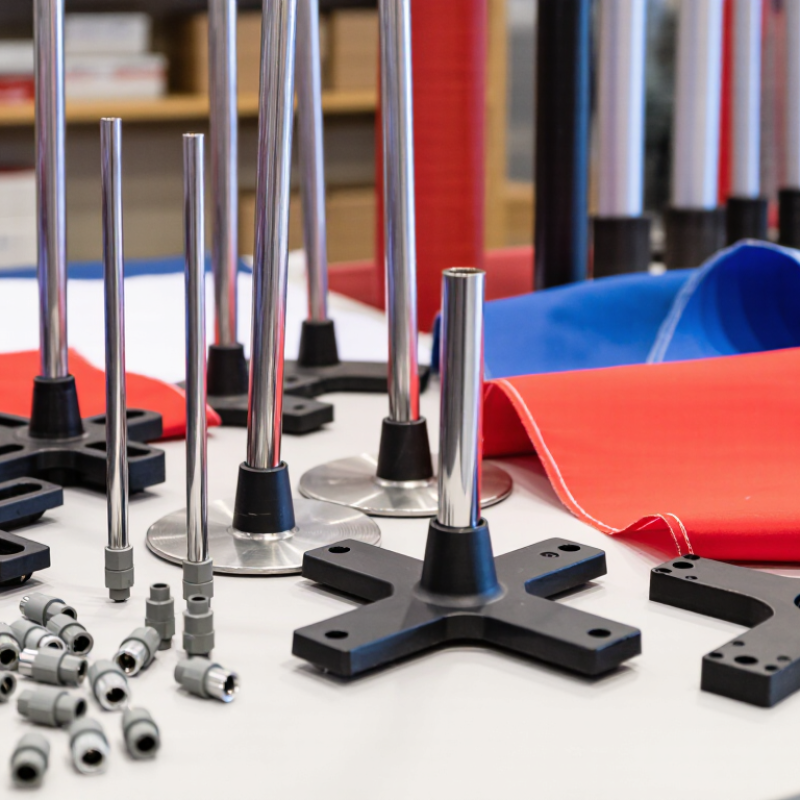
Flag Hardware Basics: Poles, Bases, Rotators, and Mounting Systems
Flag hardware performs best when its parts are matched to the flag, site, and expected wind. A pole should be tall enough for clear visibility, yet manageable during installation. Check its material, diameter, joint strength, and finish. A flexible pole may suit a beach flag, while a sturdier pole can support larger fabric outdoors. The fit matters.
Bases keep the display upright. Flat cross bases work on level indoor floors, while ground spikes suit soft soil. Water- or sand-fillable bases add weight, but need regular checks for leaks and shifting. Rotators let the flag turn with changing wind, reducing fabric twist. Mounting systems should hold firmly without crushing the pole; inspect clamps, screws, and contact points before use. I have seen a small mismatch cause wobbling, even when each part seemed well made. That detail is easy to overlook.
Tips: Match pole diameter to the base or mount. Test the assembled setup before placing it in a busy area. Check for loose fittings, sharp edges, and a base that rocks on the ground. Wind conditions change, and hardware needs attention too.
Get in touch
Our mission is to develop cutting-edge clean energy technology and provide next-generation solar inverters.
Phone
(888) 598-9901
nep-usa@site_ea168614-f5f4-4298-bd5b-880b4cf8d99d
