We use our own and third-party cookies to improve our services. If you continue browsing, we will consider that you accept this use. Read More

OK

English-US
  • Spanish-Latin America
  • Japanese-JP
  • Chinese
  • Europe
  • Português-BR

Tech Support

(888) 598-9901
Hours: Mon-Fri 8AM-8PM EST

E-mail

nep-usa@site_ea168614-f5f4-4298-bd5b-880b4cf8d99d

China Top 10 Ways to Lower Your Electricity Bill?

A high electricity bill can feel mysterious: the meter keeps turning, but the reasons are often hiding in ordinary routines. In China, summer air-conditioning, water heaters, refrigerators, and standby devices can all add to household consumption. The best savings usually come from measuring first, then changing habits and equipment. Small adjustments matter. So does knowing your local tariff.

Energy-efficiency expert Amory Lovins, co-founder of Rocky Mountain Institute, has long championed getting more value from each unit of energy. Put simply, his principle is: “Use less energy for the same comfort.” This is a paraphrase, not a verbatim quotation. It offers a useful lens for the ten ideas ahead, from setting air-conditioning temperatures sensibly to comparing appliance labels and shifting flexible tasks away from peak periods where local pricing supports it. A lower electricity bill should not mean an uncomfortable home.

The right choices depend on your city, household size, climate, and utility plan. Check your own meter readings and bill details before assuming one device is the main culprit. A one-week log can reveal patterns: the air conditioner running with open windows, perhaps, or a water heater left on overnight. Not every tip will fit every home. Some changes cost money upfront, and savings can be smaller than expected. Still, clear measurements make better decisions possible.
China Top 10 Ways to Lower Your Electricity Bill?

Understand How Electricity Billing Works in China

In China, a household electricity bill is based mainly on the kilowatt-hours recorded by its meter and the residential tariff set for its location. Many provinces use tiered pricing: as annual household use passes local thresholds, the price for additional electricity can rise. The National Development and Reform Commission’s guidance on residential tiered pricing leaves provinces room to set their own thresholds and rates. So a neighbor in another province may face different steps. Check the tariff table for your city, not a nationwide estimate.

The China Electricity Council reported that urban and rural household electricity use reached about 1.35 trillion kWh in 2023. That figure describes national consumption, not an individual bill, but it shows why household usage matters. Look at the meter reading and billing period together; a long billing cycle can make a bill look unexpectedly high. Small details matter. If your home has time-of-use pricing, confirm whether it applies automatically or requires enrollment. Rates and eligibility vary locally, and shared rentals can make meter readings harder to verify. I would not assume a high bill proves waste: weather, heating, cooling, and billing dates can all change the total.

China: 10 Practical Ways to Lower Your Electricity Bill

Understand how electricity billing works in China and see example annual electricity savings from common household changes.

How to read this chart: Bars show estimated electricity saved in kWh per year, not money. Each estimate uses the example assumptions in the labels; actual savings depend on appliance power, usage, and household habits.

How billing works: A household bill is generally based on electricity used (kWh) and the applicable local tariff. Many areas use tiered residential pricing, where rates can rise as annual consumption crosses local thresholds. Tariff rates and thresholds vary by location, so check your local utility bill or official tariff notice to estimate savings in yuan.

Identify the Main Sources of Household Electricity Use

Identify the Main Sources of Household Electricity Use

A household’s electricity bill often reflects a few high-use appliances, not every light left on. Air conditioners and electric heaters can consume substantial power, especially during hot summers or cold winters. Water heaters, refrigerators, rice cookers, and clothes dryers also add up. Short bursts matter less than appliances that run for hours. Still, the exact pattern depends on your home, habits, and local tariff.

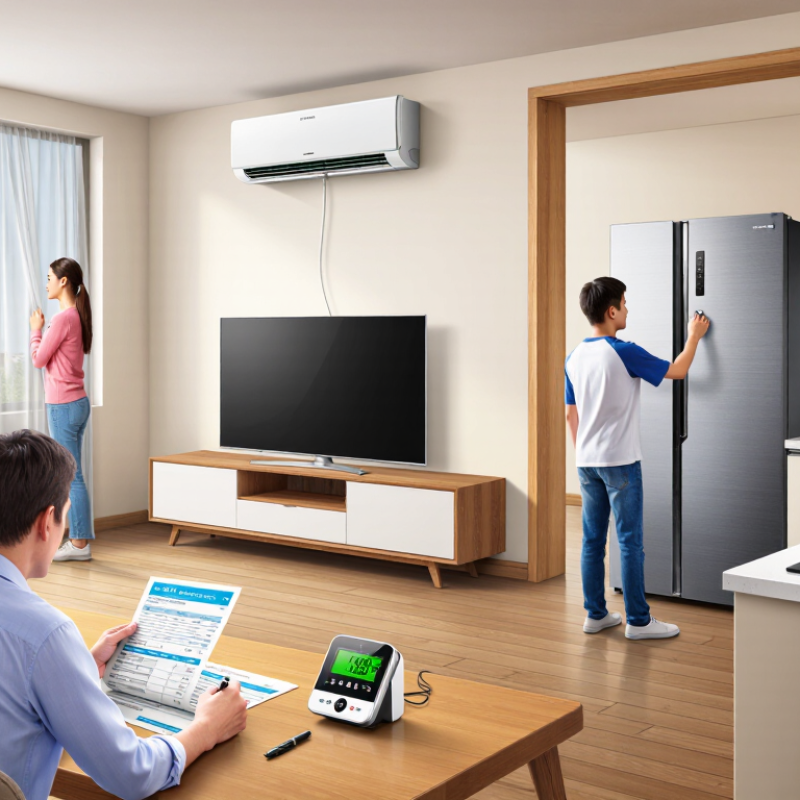
Tips: Check your electricity meter at the same time each day for a week. Note air-conditioner use, water heating, and cooking times. Compare readings on days when one appliance is used less. A plug-in energy meter can help measure suitable appliances; never use one with equipment beyond its rated capacity. Small steps help.

Look at appliance labels for wattage, then consider both power and running time. A 1,500-watt heater used for several hours may draw more electricity than a small lamp used all evening. Refrigerators cycle throughout the day, so poor door seals or very low temperature settings can increase consumption. It is easy to blame standby lights, but large heating and cooling loads may matter more. I might overlook cooking habits, too; tracking real use is more useful than guessing.

Choose Energy-Efficient Appliances and Lighting

In Chinese homes, air conditioners and refrigerators deserve close attention because they run for many hours. The International Energy Agency reported that cooling accounts for about 10% of global electricity consumption in its 2018 Future of Cooling analysis. When replacing an appliance, compare its annual electricity use in kilowatt-hours, not just its purchase price. Check the China Energy Label and measure the old refrigerator’s temperature settings and door seal. Small details matter. An efficient model still wastes electricity if its door stays open or its thermostat is set unnecessarily low.

Lighting is an easy place to make a visible change. The U.S. Department of Energy reports that LED bulbs use up to 90% less energy and last up to 25 times longer than incandescent bulbs. Replace bulbs in frequently used rooms first, such as the kitchen or living room, and choose brightness for the task rather than buying the highest-wattage option. I would not assume every household sees the same savings: usage patterns, appliance age, and local tariffs all affect the bill. One overlooked step is recording a month of meter readings before and after a change; without that comparison, the savings can feel smaller—or larger—than they really are.

Adjust Heating, Cooling, and Water-Heating Settings

In much of China, cooling and water heating can quietly raise household electricity use. Hot, humid summers make air conditioning feel essential, while northern winters bring different heating needs. The International Energy Agency’s 2018 report, The Future of Cooling, estimates that air conditioners and fans use about 20% of electricity in buildings worldwide. That makes thermostat settings worth a closer look. Set cooling near 26°C when comfortable, and use a fan to improve air movement. Keep doors and windows closed while the unit runs. I still forget this on rushed evenings. Clean filters regularly, too; a dusty filter can restrict airflow.

In colder rooms, try setting heating around 18–20°C, then adjust for comfort and household needs. Avoid heating empty rooms for long periods. For electric storage water heaters, use a timer to heat water shortly before regular bathing, rather than keeping it hot all day. Follow the appliance’s instructions for a safe temperature; turning it too low may create hygiene risks. Insulating exposed hot-water pipes can reduce heat loss between the tank and tap. A warmer shower is tempting. But shorter showers and repairing a dripping hot tap can also trim wasted energy, though results vary with household habits and equipment.

Use Electricity During Lower-Cost Time Periods and Track Savings

Using electricity during lower-cost hours works only when your local tariff rewards the shift. China’s National Development and Reform Commission, in its 2021 time-of-use pricing guidance, called for a peak-to-valley price ratio generally no lower than 3:1 in applicable areas. This is a policy benchmark, not a guaranteed household rate; check your utility’s current tariff and time slots. A dishwasher run after midnight may cost less, but only if your plan lists those hours as off-peak.

Track the difference for a full billing cycle. Record your meter reading, appliance use, and bill before changing routines, then compare the next cycle under similar conditions. Shift flexible loads, such as laundry or water heating, rather than running every appliance at once. A simple spreadsheet can show whether savings exceed any extra usage. Weather, occupancy, and billing periods can distort the comparison. Mine did once.

Tips: Note peak and off-peak hours beside your meter. Compare kilowatt-hours and total cost weekly. Keep the original routine for a few days as a baseline.

China Top 10 Ways to Lower Your Electricity Bill? - Use Electricity During Lower-Cost Time Periods and Track Savings

Time-of-use periods and residential electricity prices vary by province, city, customer category, and local tariff rules. Check your latest bill or local utility notice for the applicable schedule. The price figures below are illustrative assumptions for demonstrating the savings calculation, not official rates.

No. Action How to Apply It What to Track Example Monthly Saving
1 Shift flexible electricity use to lower-cost hours Run suitable appliances during the lower-price period shown on your local tariff, rather than during a higher-price period. Energy shifted (kWh) and the price difference (yuan/kWh). At an illustrative price difference of ¥0.70/kWh, shifting 2 kWh per day for 30 days saves about ¥42.
2 Schedule laundry for lower-cost periods Use a delayed-start setting when available, while following appliance safety instructions and avoiding unattended operation if not recommended. Laundry-cycle energy use and the time each cycle runs. Depends on the measured kWh per cycle and your local peak-to-off-peak price difference.
3 Heat water at a lower-cost time If your water heater has a timer or storage tank, heat water during a lower-price period and use the stored hot water later. Heater kWh, heating time, and comfort or hot-water needs. Calculate as kWh shifted × your applicable price difference; avoid heating more water than needed.
4 Charge an electric vehicle during lower-cost hours Where a vehicle and charging setup support scheduled charging, set charging times according to the local tariff and charging needs. Charging kWh, charging period, and billed rate. For 100 kWh shifted monthly and an illustrative ¥0.70/kWh price difference, the saving is about ¥70.
5 Use a dishwasher or other deferrable appliance strategically Move operation to lower-cost hours only when the appliance’s instructions and household safety practices allow it. Cycle count, energy per cycle, and operating time. Estimate from the appliance’s measured energy use and the difference between the two tariff periods.
6 Reduce avoidable use during higher-price periods Turn off unnecessary lighting and equipment, and postpone non-urgent tasks when the local peak-price period applies. Peak-period kWh before and after the change. Saving equals peak-period kWh avoided multiplied by the applicable peak rate.
7 Use appliance timers carefully Set schedules for eligible appliances, then confirm that the timer does not cause operation during an unintended tariff period. Scheduled start time and actual start time. Varies with the amount of use successfully moved to a lower-priced period.
8 Measure appliance consumption Use the electricity meter’s available readings or a suitable energy meter to identify which flexible loads use the most electricity. kWh per day or cycle for the selected appliance. Measurement helps prioritize the largest flexible loads; it does not create savings by itself.
9 Compare bills month by month Record total kWh, bill amount, billing days, and any tariff-period breakdown shown on the bill. Monthly kWh, total charge, and peak/off-peak usage if available. Compare similar billing periods and account for changes in weather, occupancy, and tariff rates.
10 Review and adjust your schedule regularly Check local tariff updates and household routines, then revise appliance schedules when the applicable time periods change. Monthly shifted kWh and estimated savings. Use the current local rates each month; do not rely on a time schedule from another city or province.
Illustrative calculation: 2 kWh shifted per day × 30 days × (¥1.00/kWh peak − ¥0.30/kWh lower-cost period) About ¥42/month

Get in touch

Our mission is to develop cutting-edge clean energy technology and provide next-generation solar inverters.

Phone

(888) 598-9901

E-mail

nep-usa@site_ea168614-f5f4-4298-bd5b-880b4cf8d99d