- Spanish-Latin America
- Japanese-JP
- Chinese
- Europe
- Português-BR

Tech Support
(888) 598-9901
Hours: Mon-Fri 8AM-8PM EST
nep-usa@site_ea168614-f5f4-4298-bd5b-880b4cf8d99d
What Is a Car Parking Lift and How Does It Work?
A Car Parking Lift creates more parking capacity without expanding a building’s footprint. It moves vehicles vertically, using platforms, guide rails, motors, and safety controls to place cars in stacked spaces. Picture a car easing onto a steel platform in a garage. With the operator’s controls, the platform rises or lowers, revealing another parking space beneath it. The movement looks simple. The engineering is not.
Different systems suit different sites. A two-post lift may serve a home garage, while a larger automated system can store many vehicles in a commercial facility. Capacity, vehicle dimensions, ceiling height, access routes, and maintenance needs all shape the choice. A lift is not simply a machine that saves space; it is part of a carefully planned parking environment.
A useful design principle is: “Every saved square metre depends on safe, predictable movement.” This is an editorial summary, not a verified quotation from a named industry expert; no source was provided to confirm an expert’s words. That distinction matters. Readers deserve evidence, not a polished but invented attribution. This guide explains how a Car Parking Lift works, what its main components do, and where its practical limits appear. Compact parking can be valuable. It can also demand careful operation, regular inspection, and realistic planning. The details matter.
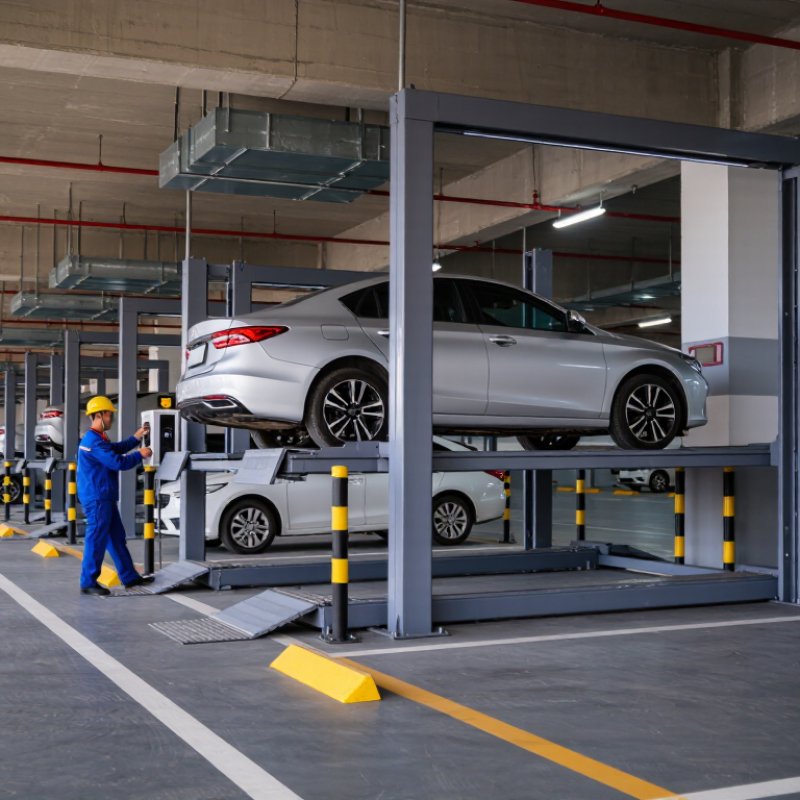
What a Car Parking Lift Is
A car parking lift is a mechanical structure that stores one vehicle above another, using vertical space instead of requiring a second ground-level bay. It usually includes a load-bearing platform, support columns, a lifting mechanism, and safety locks. Some lifts serve two cars; larger systems can store several vehicles across multiple levels. Compact footprint, substantial hardware.
The lift’s rated capacity and platform dimensions determine which vehicles it can hold. The U.S. Environmental Protection Agency’s 2023 Automotive Trends Report puts average new-vehicle weight at about 4,300 pounds for model year 2022. That figure is context, not a design specification: individual vehicles vary, and accessories or cargo add weight. A lift must be selected using its documented load rating, platform width, and clearance—not an average alone.
In a simple two-level lift, a car is driven onto the platform, which rises and locks in place; another vehicle can then use the space below. Designs may use hydraulic or electromechanical lifting systems. The floor, ceiling height, vehicle dimensions, and access route all affect suitability.
A detail that is easy to overlook: a vehicle may meet the weight limit yet still be too tall or wide for the platform. A site assessment helps catch that mismatch.
Get in touch
Our mission is to develop cutting-edge clean energy technology and provide next-generation solar inverters.
Phone
(888) 598-9901
nep-usa@site_ea168614-f5f4-4298-bd5b-880b4cf8d99d
