- Spanish-Latin America
- Japanese-JP
- Chinese
- Europe
- Português-BR

Tech Support
(888) 598-9901
Hours: Mon-Fri 8AM-8PM EST
nep-usa@site_ea168614-f5f4-4298-bd5b-880b4cf8d99d
2026 Top Suction And Discharge Hose Types for Global Buyers?
Choosing the right Suction And Discharge Hose can influence transfer safety, service life, and operating cost. Global buyers face many options, including rubber, PVC, thermoplastic, composite, corrugated, and layflat designs. Each type responds differently to pressure, vacuum, temperature, chemicals, abrasion, and weather.
This guide examines the leading hose types expected to attract attention in 2026. It focuses on practical selection details, not impressive labels alone. A chemical transfer hose may require different tube materials than a dredging hose. A food-grade application needs cleanable surfaces and suitable certifications. An oil hose may need resistance to swelling, static buildup, and repeated flexing.
Small details matter.
We will compare construction, pressure ratings, flexibility, coupling methods, and typical service environments. We will also consider hose diameter, working length, bending radius, reinforcement layers, and storage conditions. These factors can affect installation time and unexpected replacement costs. Experienced buyers often inspect the actual fluid, temperature range, suction level, and connection hardware before placing an order.
No single hose wins every application. That assumption is easy to make, and often wrong. Product data sheets may also differ in testing methods, so direct comparisons require care. Our comparison is not flawless; field conditions can expose weaknesses that laboratory figures miss. Still, this overview offers a reliable starting point for distributors, engineers, contractors, and industrial purchasers. It helps readers ask better questions before choosing a hose for water, fuel, chemicals, slurry, food products, or bulk materials.
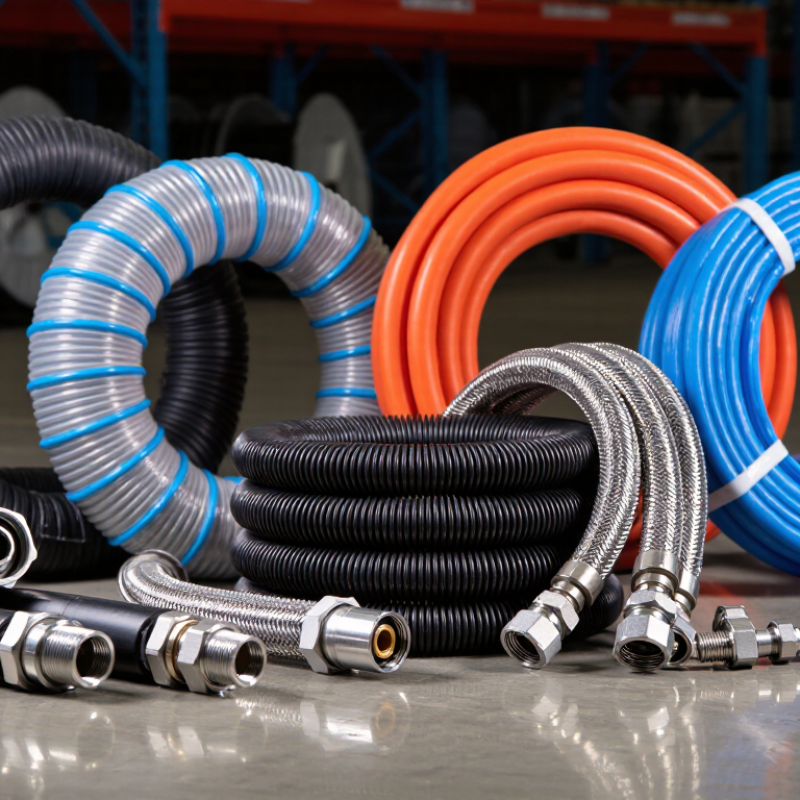
What Suction and Discharge Hoses Do: Vacuum, Pressure, and Flow Roles
Suction and discharge hoses perform different jobs, even when they look similar on a warehouse shelf. A suction hose must resist collapse under vacuum. Its spiral reinforcement keeps the bore open while a pump pulls liquid through it. A discharge hose handles positive pressure instead. It needs strong reinforcement, secure couplings, and a working pressure rating that suits the system.
Common choices include PVC suction hoses for light water transfer, rubber hoses for demanding industrial service, and thermoplastic hoses for lower weight and flexible handling. Composite hoses can suit chemical or fuel transfer when their construction matches the fluid. However, material names alone do not prove suitability. Temperature, abrasion, bending radius, and fluid compatibility matter just as much.
Flow depends on more than hose diameter. A narrow bore creates friction, reduces delivery, and may increase pump strain. A hose that is too large can become heavy and difficult to control. In field checks, I look for flattened sections, loose clamps, and sharp bends near the pump connection. These details often explain poor performance. Many buyers focus on pressure first. That assumption can fail. Vacuum rating, suction lift, operating temperature, and coupling quality deserve equal attention. A small installation sketch can expose problems before shipping and setup costs grow.
Get in touch
Our mission is to develop cutting-edge clean energy technology and provide next-generation solar inverters.
Phone
(888) 598-9901
nep-usa@site_ea168614-f5f4-4298-bd5b-880b4cf8d99d
